
From Ancient Greece to Dermophthalmology – Hygiene as the “Hidden” 50% of Success
From Ancient Greece – The Birth of Hygiene
In Ancient Greece, hygiene was not just a practice but a philosophy of life.
Hippocrates spoke of purity of body and soul, establishing the principle that “it is better to prevent than to cure.”
At the Asclepieia – the first “hospitals” of the ancient world – care included:
- baths,
- special diets,
- exercise,
- sleeping in a clean environment.
“Catharsis” (cleansing) was considered a prerequisite for health. Without it, no therapy had value.
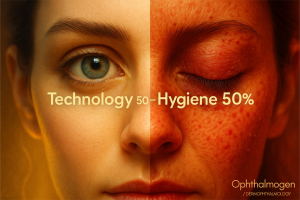
Yet 2,500 years later, while medicine has made leaps, we have neglected the simplest heritage of our ancestors: daily eye hygiene.
70 Years of Progress – The Triumph of Ophthalmic Surgery
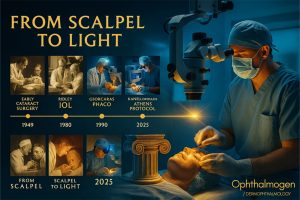
The progress of ophthalmic surgery from the mid-20th century until today is breathtaking.
- 1949 – Sir Harold Ridley: invented the first intraocular lens (IOL), paving the way for modern intervention cataract και ελληνικές χειρουργικές επιτυχίες.
- Αρχές δεκαετίας ’80 – Βασίλειος Τσίγγος Καταρράκτης:Ο Dr. Βασίλειος Τσίγγος πραγματοποιεί τις πρώτες οκτώ επιτυχημένες operations cataract with intraocular lens throughout Greece as Director at Drama Hospital in 1980.
- 80s-90s – Spyros Georgaras Phacothripsis: a technique established by Professor Spyros Georgaras in Greece, influencing Europe, turning cataracts into a painless, rapid procedure.
- 1990s – Ioannis Pallikaris: presented LASIK, the greatest revolution in refractive surgery globally.
- 2000s – Athens Protocol for the treatment of Keratoconus, introduced by NYU professor Dr. Anastasios Kanellopoulos. Before it, patients had few options, with corneal transplantations often being the final stage.
- Today: multifocal/toric lenses, corneal transplants, high-precision techniques.
Millions regained sight, independence from glasses, and a dramatically better quality of life.
The Paradox – Neglect of Hygiene
And yet, in this triumph lies a paradox:
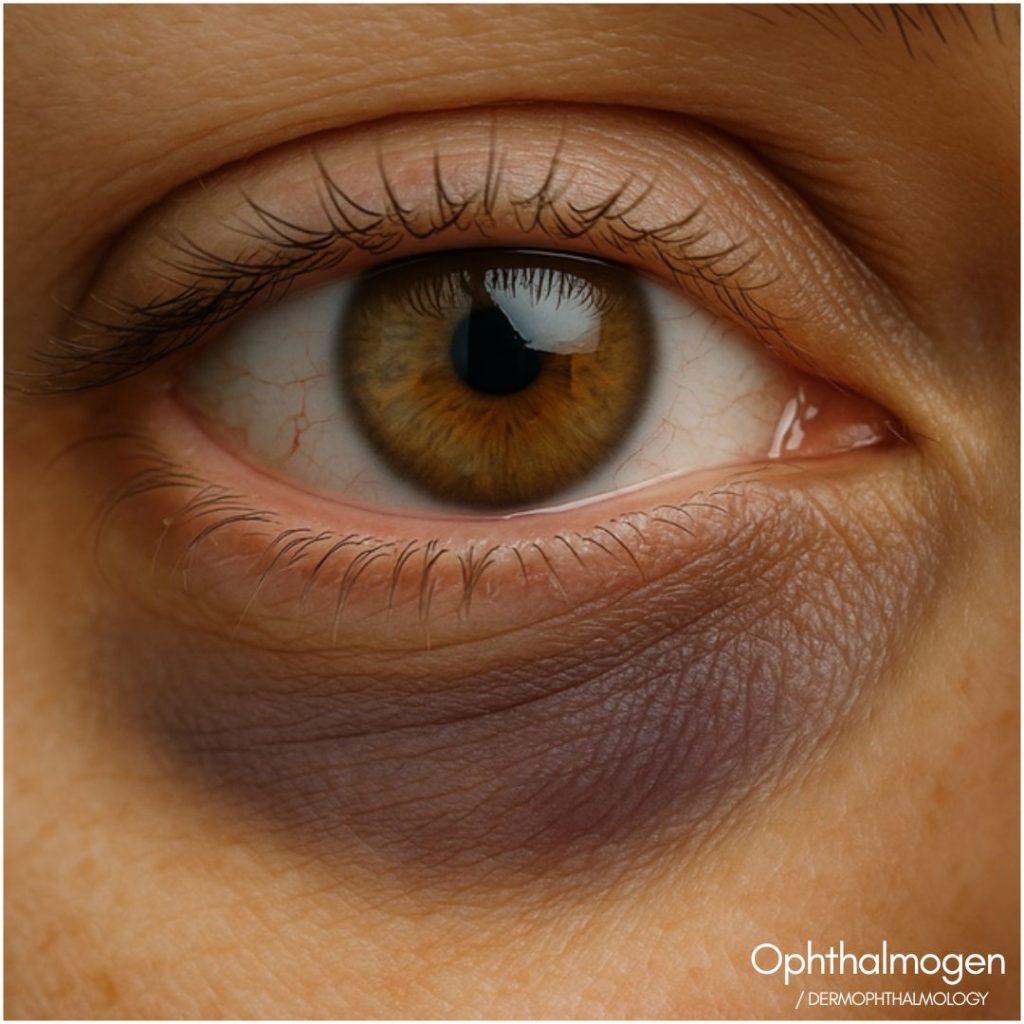
We invest in top technology, trust skilled surgeons, but forget the most basic element: care of the ocular surface and eyelids.
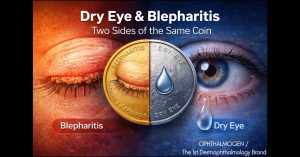
- 70–80% of cataract candidates already have dry eye/blepharitis.
- 95% of LASIK patients experience post-op dry eye.
- 40–50% of multifocal lens patients report dissatisfaction due to unstable tear film.
The surgery succeeds, but neglect of hygiene “steals” the result.
It's like building a palace on shaky ground.
The Lesson from Antiquity
The Ancient Greeks knew that without cleanliness there is no health.
Paradoxically, today, while we have million-dollar lasers and advanced IOLs, we haven’t embraced daily eyelid hygiene.
- Splashing water is not enough.
- Eyelids, like greasy pans, cannot be cleaned with water alone; they need targeted care.
- Specialized products (tea tree oil, thermotherapy, gel massage, spraying, Meibomian Gland Evacuation) are the modern version of “catharsis.”
Dermophthalmology – The New Science
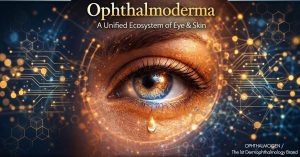
Dermophthalmology fills this gap.
- It treats the eye as part of an integrated system with eyelids, lashes, and skin.
- It applies dermatological principles: cleansing, hydration, microbial control.
- It delivers not just better vision but also healthier, younger-looking eyes.
Dermophthalmology is the natural continuation of Greece’s tradition:
From Hippocrates and “catharsis,” to Pallikaris and LASIK, to today – where eye hygiene becomes the “hidden” 50% of success.
Conclusion
Η χειρουργική έσωσε την όρασή μας.Η υγιεινή θα τη διατηρήσει.Η Ελλάδα, που χάρισε στον κόσμο τον Ιπποκράτη και τη LASIK, τώρα πρωτοστατεί στη Dermophthalmology.
Greece, which gave the world Hippocrates and LASIK, now leads with Dermophthalmology.A science that doesn’t replace ophthalmology but strengthens it, with healthier patients and better results.
We cannot speak of health and beauty if the eyes – the organ that gives us 80% of our information – are neglected.We cannot speak of progress if we forget the most basic heritage of our ancestors: hygiene.
The next revolution will not be another laser.It will be the realization that eyes need the same daily care as our teeth, skin, and hair. Surgery is the gift.Hygiene makes it lasting, comfortable, and beautiful.
References
- Ophthalmogen — Official Website
- From Isolated Diseases to the Pathological Spectrum
- Dermo-ophthalmology — Functional systemic framework & eye-skin barrier
- From Isolated Ophthalmic Entities to the Pathological Spectrum — WOD
- Global Pioneers in Ophthalmology — LASIK, Athens Protocol & Dermophthalmology
- Eye surgeries & hygiene
- From Helmholtz to Dermophthalmology
- The hygiene revolution — From Hippocrates to Dermo-Ophthalmology
- Chalazion Surgery — When and How It Evolved
- Contact Lenses — Hygiene & Patient Satisfaction
- Before cataracts — why eyelid hygiene is mandatory
- Corneal transplant & hygiene
- Eye Surgery — Eyelid Health, Success & Recovery
- After the Cataract — Watery Eyes and Hygiene as the Key
- LASIK, dry eye & hygiene — The result
- Oral hygiene & Dermo-ophthalmology