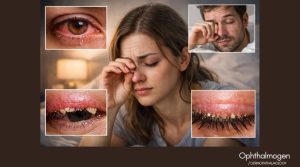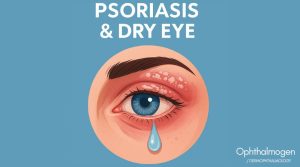

You take an antihistamine. Your allergy is under control. And yet, your eyes are:
- red
- dry and irritated
- tired
- Sometimes watering, sometimes feeling tight and uncomfortable
And then the natural question arises: “If I’m taking an antihistamine, why do my eyes feel worse?”
If you are using medications such as:
- Zyrtec® / Xyzal®
- Aerius®
- Claritine®
- Telfast® / Allegra®
- Rupafin®
…you are not alone. And it is not your fault.

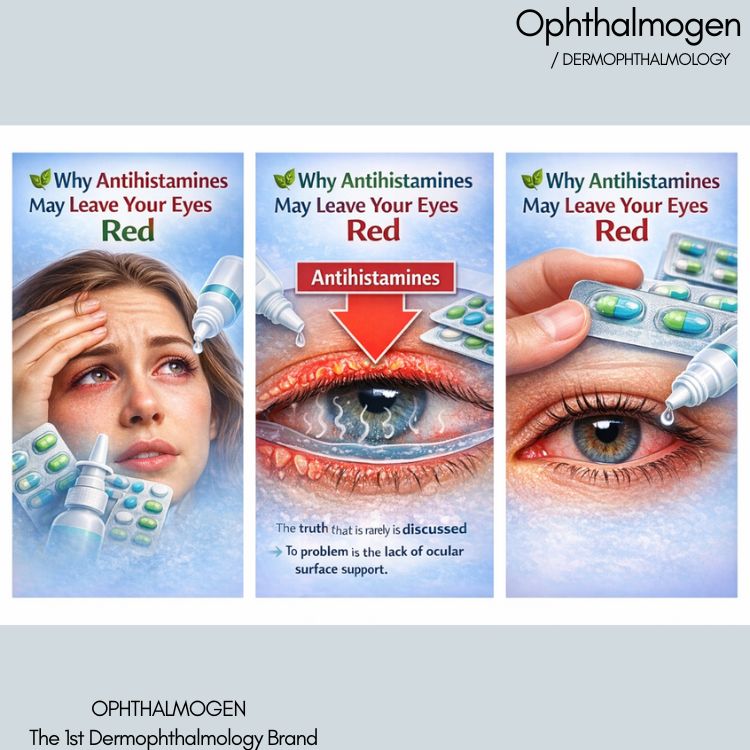
The truth that is rarely discussed
Antihistamines are essential medications. They control allergic reactions by blocking histamine H1 receptors and reducing allergic inflammation. However, scientific studies have shown that their effects are not limited to the nose or the airways, but extend to:
•the lacrimal (tear) glands
•eyelid function
•tear film stability
(Ousler GW et al., Clinical Therapeutics; Abelson MB et al., Survey of Ophthalmology)
The problem is not the medication.The problem is the lack of ocular surface support.
The “Red Eye Paradox”
In everyday clinical practice, a confusing phenomenon is frequently observed:
•The allergy is controlled
•There is no active allergen exposure
•And yet, the eyes remain red
This phenomenon is known as the Red Eye Paradox and is associated with:
- Vasodilation
- tear film instability
- eyelid dysfunction
(Nichols KK et al., Investigative Ophthalmology & Visual Science)
It’s not about “not having enough tears”
According to TFOS DEWS II (2017) — the most comprehensive global scientific consensus on dry eye disease: The most common cause of ocular redness and discomfort is not tear deficiency, but evaporative dry eye.
In other words:
•tears are present
•but they evaporate too quickly due to lipid layer instability
The root of the problem: the eyelids
Eyelids are not just “skin around the eye.” They are a functional organ of the ocular surface:
•they host the Meibomian glands
•they regulate the lipid layer of the tear film
•they determine tear film stability and longevity
Chronic ocular surface inflammation is maintained primarily by the eyelids, not by the eyeball itself
(Baudouin C et al., The Ocular Surface)
What studies show about antihistamines and the eyes
Clinical studies demonstrate that antihistamines:
•reduce tear secretion
•increase tear evaporation
•impair Meibomian gland function
•worsen tear film instability
(Welch D et al., Clinical Drug Investigation; Bielory L., Current Opinion in Allergy & Clinical Immunology)
This explains why: the allergy is controlled, but the eyes remain red.
Nose – Eyes – Lungs: one integrated system
According to the United Airway Concept (ARIA):
The nose, eyes, and lungs function as a single inflammatory system
(Bousquet J. et al., Journal of Allergy and Clinical Immunology)
Chronic nasal inflammation activates naso-ocular reflexes, leading to:
• tearing
• redness
• ocular heaviness
(Baroody FM, Current Allergy and Asthma Reports)
Are artificial tears enough?
Artificial tears:
•provide temporary hydration
•offer short-term relief
However
• they do not restore the lipid layer
• they do not improve eyelid function
•they do not address the root cause
(TFOS DEWS II)
The modern approach: eyelid care
- Dermophthalmology views the eye as a unified system: eyelids – eyelashes – ocular surface. For antihistamine users, daily eyelid hygiene is not optional — it is preventive ocular care.
In Summary
• Antihistamines are not “bad”
• But they are not sufficient for ocular health
• Dry eye is an expected side effect
• Eyelid care is evidence-based medicine
• Quality of life can improve significantly