
It’s not sleepiness.It’s not always your prescription.And it is certainly not normal.Morning blurry vision is one of the most common — and most misunderstood — visual complaints of modern life.Millions of people wake up every morning and:
- see blurry
- need time for vision to “clear”
- feel heavy or sticky eyelids
- notice improvement after blinking or washing the eyes
- see better as the day progresses
Most people blame fatigue — or simply ignore it.But this symptom is not random.And very often, it does not start inside the eye.It starts in the system that supports it.
When You Wake Up and the World Looks Blurry
Morning blurry vision has one defining characteristic:
- It is not constant.
- You don't see things permanently blurry.
- It does not progressively worsen throughout the day.
Instead:
- it is more intense in the morning
- Improves gradually
- Often disappears completely during the day
This alone tells us something crucial:The problem is not structural.It is functional.

What Morning Blurry Vision Is Not
Let’s clarify what this symptom usually is not:
- not necessarily a change in prescription
- not a lens problem
- not a neurological disorder
- not a “normal sign of aging”
In many patients:
- visual acuity tests are normal
- the cornea appears clear
- no structural damage is detected
And yet, the symptom persists.
The Paradox of Morning Blurred Vision
Many patients describe: "When I wake up, my vision is blurry, but after a while it clears up." This paradox is key.
The problem was:
- the cornea
- the lens
- the optic nerve
it wouldn't improve on its own.The fact that the picture is changing shows that:
- something superficial affects the quality of vision
- and this something changes throughout the day
Vision Is Not Just “Inside the Eye”
We often forget something fundamental: Vision does not only depend on:
- the cornea
- the lens
- the retina
It also depends on the optical surface in front of the eye.
- The tear film.

The Tear Film Is an Optical Surface
The tear film is not just moisture.It is a high-precision optical interface. It consists of three functional layers:
- Lipid layer (produced by the Meibomian glands of the eyelids)
- Aqueous layer
- Mucin layer
The lipid layer:
- reduces evaporation
- reduces evaporation
- stabilizes vision
When this layer fails:
- the tear film breaks
- the surface becomes uneven
- light scatters
and vision becomes blurred.
TFOSDEWSII (2017)
defines dry eye disease and reduced visual quality as a multifactorial disorder of the ocular surface, with tear film instability at its core.
What Happens to the Eyes During the Night
Nighttime is critical.During sleep:
- blinking stops
- eyelids remain still
- Meibomian glands are not naturally expressed
- meibum stagnates
- the tear film is not renewed
The eyelid environment becomes:
- warmer
- more lipid-rich
- closed and stagnant
Ideal conditions for accumulation and dysfunction.
Morning routine:
- the tear film is thick and unstable
- the surface is optically uneven
- vision appears blurry
Why Blinking Temporarily Improves Vision
Many people notice:“When I blink a few times, I see better.”
This happens because blinking:
- spreads the tear film
- temporarily smooths the surface
- partially restores optical quality
But:It does not fix the underlying problem.
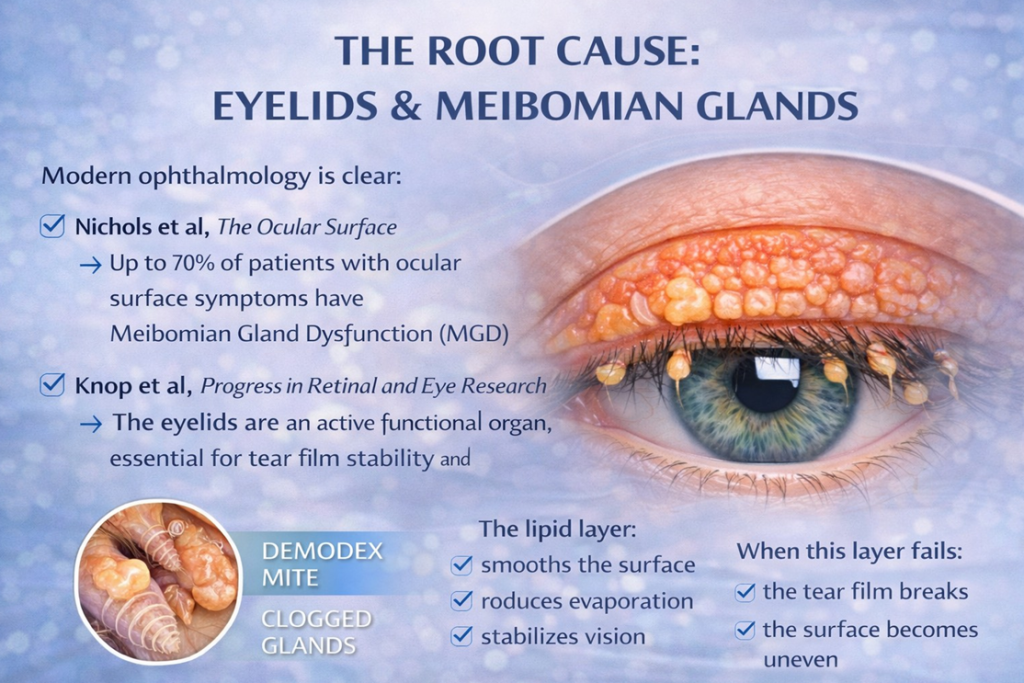
The Root Cause: Eyelids & Meibomian Glands
Modern ophthalmology is clear:
Nicholsetal., The Ocular Surface→ Up to 70% of patients with ocular surface symptoms have Meibomian Gland Dysfunction (MGD).
Knopetal., Progressin Retinaland Eye Research:→ The eyelids are an active functional organ, essential for tear film stability and visual quality.
If the glands do not function properly:
- the lipid layer fails
- vision quality suffers
The Role of Demodex in Morning Blurry Vision
Demodex is a microscopic mite that naturally inhabits human skin. In the eyelids:
- it resides in eyelash follicles
- it is night-active
- it feeds on lipids (meibum)
Clinical studies show:
- chronic blepharitis and morning symptoms.
- Demodex is present in 60–80% of patients
Night activity:
- increases eyelid inflammation
- contributes to gland blockage
- worsens tear film instability
The eyes do not rest at night.They accumulate load.

Why We Would Never Accept This in Any Other Part of the Body
Think about it: Teeth: If we stopped brushing and woke up daily with plaque and bleeding — would we call that normal?
Skin: If we never cleansed it and inflammation appeared — would we be surprised?
Scalp: If we never washed it and irritation developed — would we ignore it?
And yet, this is exactly what we do with eyelids.
Morning Blurry Vision Is a Message
It is not:
- sleepiness
- imagination
- aging
It is a signal that the integrated system(eyelid skin – eyelids – eyelashes – glands – tear film)is not functioning harmoniously.
The Dermophthalmology Solution
Dermophthalmology treats the eye as one functional system, not isolated parts.This is where the Ophthalmogen 3-Step Approach fits naturally.
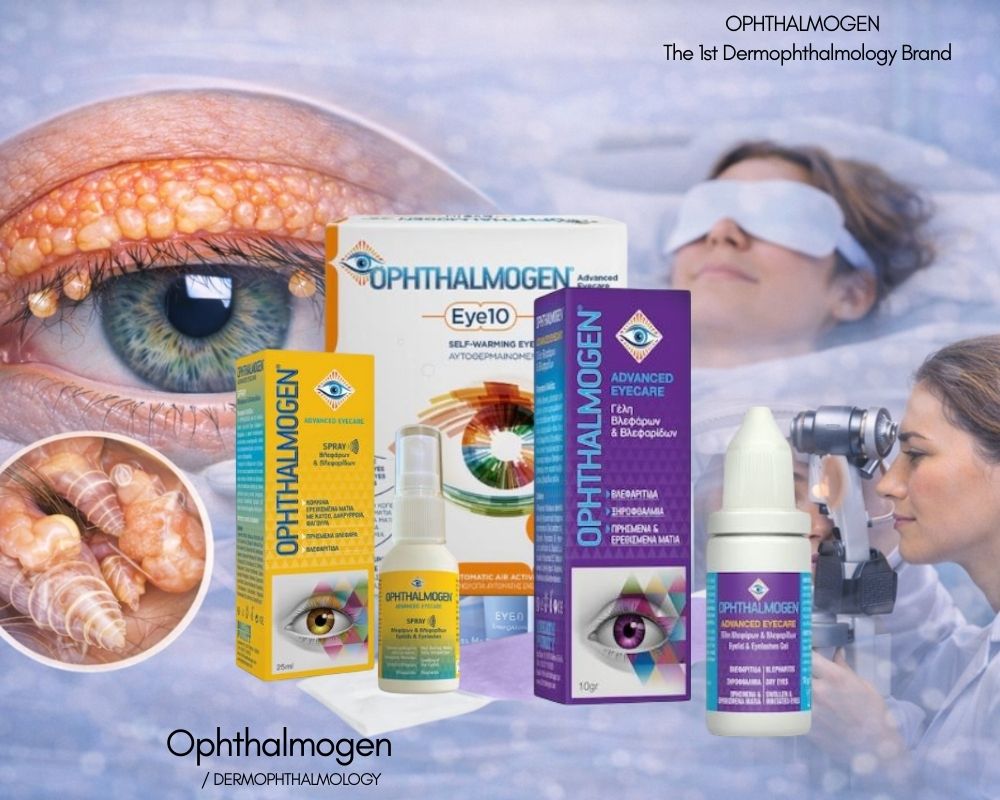
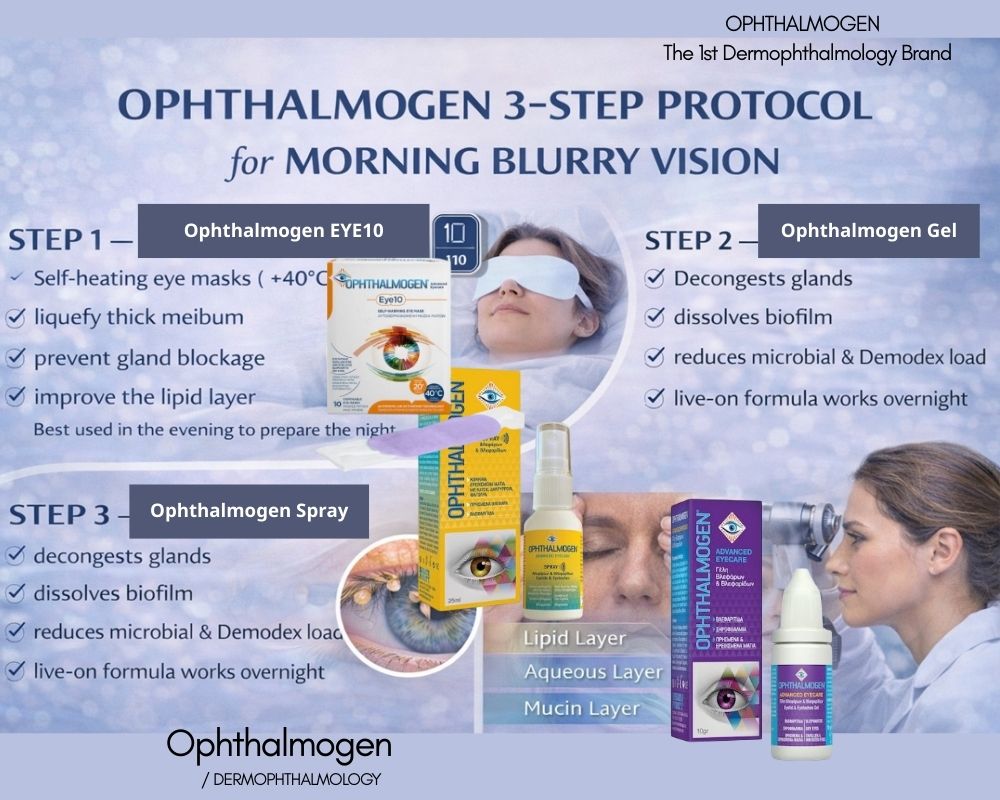
Ophthalmogen 3-Step Protocol for Morning Blurry Vision
STEP 1 — Ophthalmogen EYE10
Self-heating compresses (~40°C)
- liquefy thick meibum
- prevent gland blockage
- improve the lipid layer
- reduce nighttime stagnation
Best used in the evening to prepare the night.
STEP 2 — Ophthalmogen Gel
Functional eyelid massage
- decongests glands
- dissolves biofilm
- reduces microbial &Demodex load
- live-on formula works overnight
STEP 3 — Ophthalmogen Spray
Daily stabilization & comfort
- hydrates eyelid skin & lashes
- supports the microbiome
- reduces recurrent inflammation
- ideal during the day
When Improvement Begins
Many users report:
- less blurred vision in the morning in a few days
- clearer picture
- less need to blink
- more stable vision during the day
FAQ
Is it normal to see blurry in the morning?
No. It indicates functional instability.
Is it my glasses?
Usually not, if vision improves during the day.
Do artificial tears help?
They help symptomatically but do not restore gland function.
Final Message
If your vision is blurry in the morning:
- it is not a personality trait
- it is not age
- it is not something to ignore
It is a message from your eyelids.And today — thanks to modern ophthalmology and Dermophthalmology —there is finally a clear explanation, a scientific framework, and a practical solution.Your eyes are not failing.The system is asking for care.