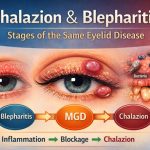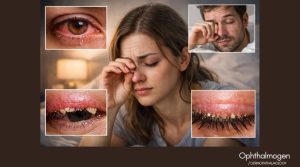

It’s not just fatigue. It’s not always “dry eye.” And it is definitely not normal.
Introduction — A Symptom Millions of People Live With
If at the end of the day you feel that:
- your eyes burn
- they sting when you close them
- they turn red after hours in front of screen work
- they feel heavy and excessively tired
- you only feel relief when you close them
- you sense that “something is wrong,” but can’t quite define it
then you belong to a huge, silent group of people living with ocular discomfort — and accepting it as something expected.
- Office workers.
- People in front of screens.
- Contact lens users.
- People under mental fatigue.
And yet, something must be said clearly:Burning eyes at the end of the day are not normal.They are a symptom.And very often, they do not start from the eye itself.They start from the eyelids.
Why Burning Eyes Are Not Simply “Dry Eye”
The term dry eyes is often used loosely.In reality:
- many people with burning eyes see 20/20
- eye examinations appear normal
- there is no visible damage to the eyeball
And yet, the symptom persists.This happens because:the problem is not always the tear — but the system that stabilizes it.
This system is scientifically described as the Blepharo–Skin Axis,the foundation of Dermophthalmology: This framework belongs to the broader field of Dermophthalmology,which approaches the eye as a unified functional organ.

What Happens to Your Eyes Throughout the Day
During the day — especially with screen exposure:
- natural blinking decreases
- eyelids become fatigued
- Meibomian glands do not empty properly
- the lipid layer of the tear film thins
- tears evaporate more rapidly
The result?
- The eye becomes functionally exposed
- The cornea dries
- Sensory nerves are activated.
Burning, Stinging, Itching, Fatigue, Redness

Why Does It Mostly Appear in the Evening?
Because the eye is an organ of endurance.It can tolerate:
- hours of concentration
- screen work
- contact lens wearers
- dry air
- mental strain
But not indefinitely.When eyelids and their glands are already destabilized, fatigue accumulates.And then:the eyes burn — at the end of the day.
Why Artificial Tears Often Aren’t Enough on Their Own
Artificial tears are useful and often necessary.They can provide temporary relief during the day, such as:
They provide: hydration reduced friction temporary relief However, they do not restore eyelid function. That’s why many people say:“I use drops, but my eyes still burn at night.”

Morning Reset — A Clean Start for the Eyelids
Morning eyelid cleansing Daily cleansing with Naviblef: with lukewarm water without rubbing This helps to: remove overnight biofilm reduce microbial load prepare glands for proper function during the day
The Complete Solution
Dermophthalmology 3-Step Protocol by Ophthalmogen
To truly stop end-of-day burning, the root cause must be restored.Not just hydration.But functional eyelid care.
STEP 1 — Thermal Restoration of Meibomian GlandsOphthalmogen EYE10
- liquefies thick meibum
- opens gland orifices
- restores the lipid layer
- smooths the surface
- deeply relaxes tired eyes
- Blurs vision
STEP 2 — Functional Eyelid Massage Ophthalmogen Gel Ophthalmogen Gel
- removes debris & makeup
- dissolves biofilm
- reduces microbial load
- helps control Demodex
- decongests glands
- Increases blood flow and reduces peri-ocular discolorations
STEP 3 — Stabilization & Daily Comfort with Ophthalmogen Spray
- hydrates eyelid skin & eyelashes
- supports the microbiome
- reduces recurrent inflammation
- Reducing dry eye symptoms by improving the curvature and texture of problematic eyelashes
- provides comfort during screen use
- Easy to use
Why This Combination Works
Because:
- artificial tears help the symptom during the day
- but Ophthalmogen’s 3-step care restores the root cause
It’s not “either/or.”It’s a combined approach, as defined by modern Dermophthalmology.
Scientific Background
- TFOS DEWS II (2017)
- Nichols et al., The Ocular Surface
- Knop et al., Progress in Retinal and Eye Research
- Lemp et al.
- Luo et al., Clinical Ophthalmology

FAQ — Frequently Asked Questions
Is it normal for eyes to burn every evening?
No. Daily burning is a symptom of dysfunction.
If I see well, why do my eyes burn?
Visual acuity is not the same as functional comfort.
Are artificial tears enough?
Not on their own.
Is eyelid hygiene necessary without a diagnosis?
Yes. It is preventive care.
How long until improvement?
Usually within 2–4 weeks of consistent care.
Final Message
If your eyes burn at the end of the day:
- you are not exaggerating
- you don’t have to “get used to it”
- it is not normal
It is a message from your eyelids.And today, there is finally:understanding, a scientific framework, and a practical daily solution.