
Red eyes are one of the most common — and most misunderstood — symptoms of modern daily life.They can appear:
- after many hours in front of screens
- during allergy season
- with contact lens wear
- with dry eye
- after poor sleep or intense stress
And very often, the first thought is simple:“Let me use an eye drop to get rid of the redness.”
That’s why, for decades, vasoconstrictor eye drops have been one of the most widely used self-care choices.
But:
- redness is a symptom
- not a diagnosis
- and rarely the root cause of the problem
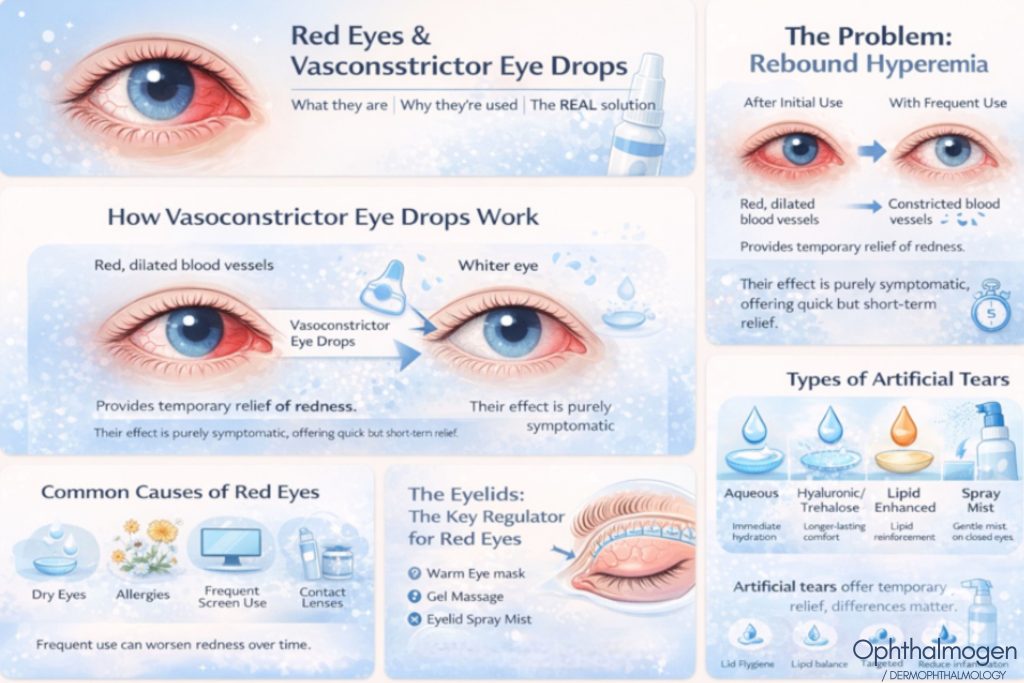
What are vasoconstrictor eye drops?
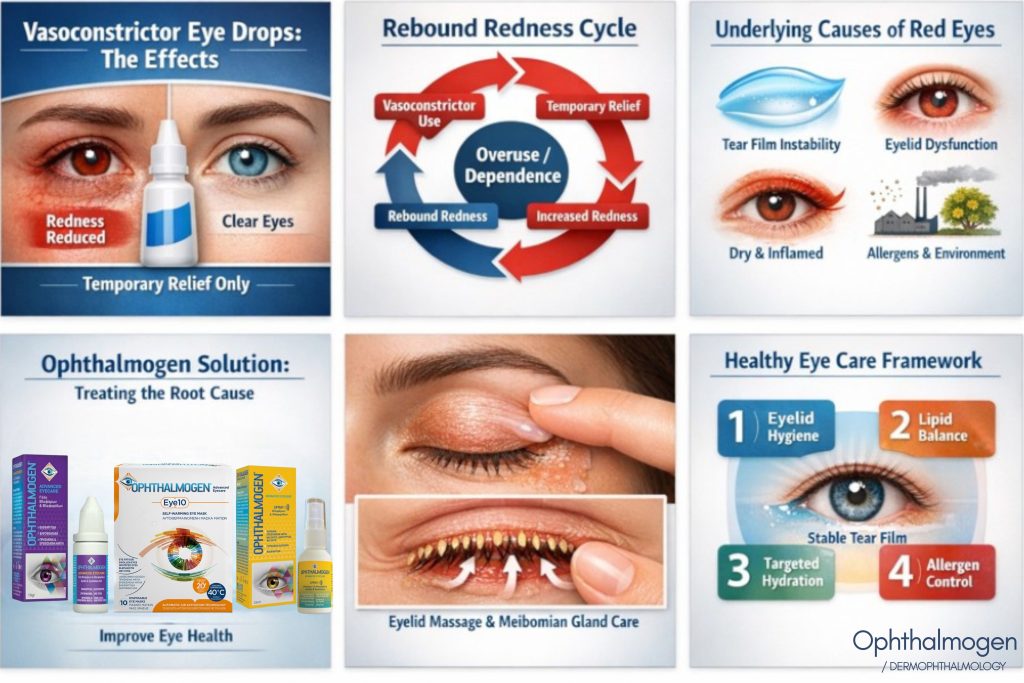
Vasoconstrictor drops contain agents that constrict the superficial blood vessels of the conjunctiva, such as:
- tetrahydrozoline
- naphazoline
- (historically) oxymetazoline
Their effect is:
- immediate
- visible
- impressive
Within minutes:
→ redness decreases
→ the eyes look “clearer”
Their action is purely symptomatic.
Why were they created? The historical context
Vasoconstrictors were developed in an era when:
- dry eye was considered rare
- eyelid dysfunction had not been recognized
- the tear film had not yet been analyzed into phases
- daily eyelid hygiene didn’t exist as a concept
Their goal was:fast aesthetic improvement of redness
Not:
- long-term treatment
- prevention
- stabilization of the ocular surface
For occasional use, their role was clear.
What they do — and what they do NOT do
What they do:
- constrict superficial vessels
- temporarily reduce redness
What they do NOT do:
- they do not reduce inflammation
- they do not meaningfully hydrate the eye
- they do not restore the tear film
- they do not improve eyelid function
In practice, they can function like make–up for the eyes.
The big issue: Reboundhyperemia — the effect that confuses people
Frequent or prolonged use may lead to :rebound hyperemia,
meaning:
- after the effect wears off
- vessels dilate more than before
- redness returns more intensely
This creates:
- a vicious cycle
- more frequent use
- a feeling of “dependence”
Abelson MB et al., Survey of Ophthalmology
Why do people keep using them?
Not out of ignorance.But because:
- the result is immediate
- they’re easy to access
- no prescription is required
- there is social pressure (work, appearance, going out)
Oculosan, Septobore & similar drops
Oculosan, Septobore & similar drops
have an occasional role
- έχουν περιστασιακό ρόλο
- offer temporary relief
- are not a daily solution
The problem is not that they exist. The problem is the wrong expectation.
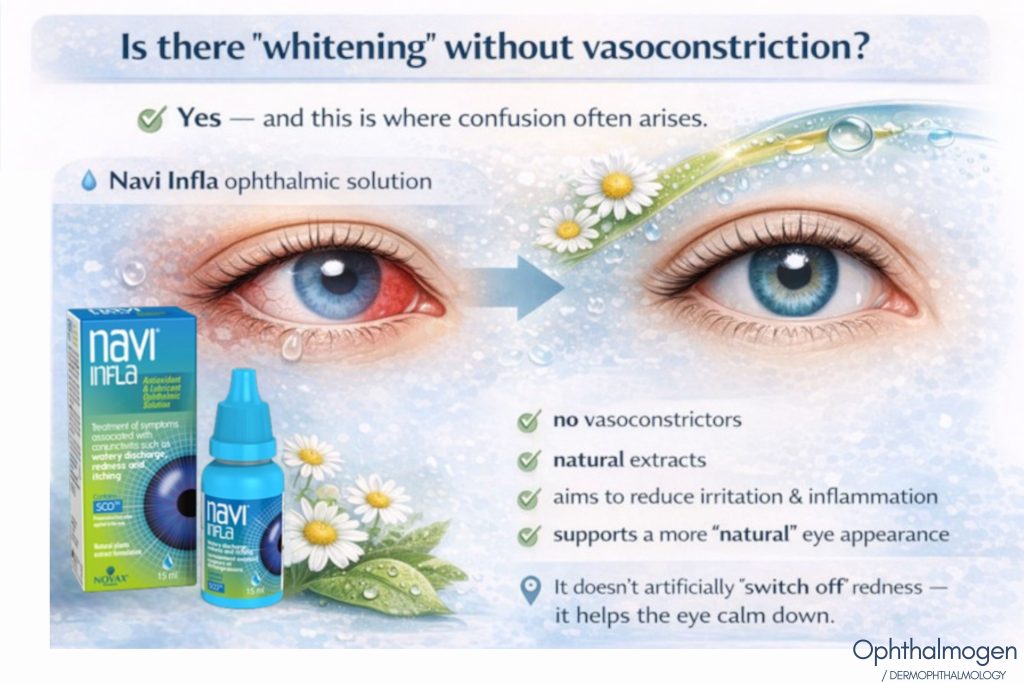
Is there “whitening” without vasoconstriction?
Yes — and this is where confusion often arises.NaviInfla ophthalmic solution
It belongs to a different philosophy:
- no vasoconstrictors
- natural extracts
- aims to reduce irritation & inflammation
- supports a more “natural” eye appearance
It doesn’t artificially “switch off” redness —it helps the eye calm down.
What is usually the real cause of red eyes?
In most cases, redness is linked to:
- tear film instability
- increased evaporation
- low-grade inflammation
- eyelid dysfunction
- allergic or environmental load
TFOSDEWSIIReport, 2017
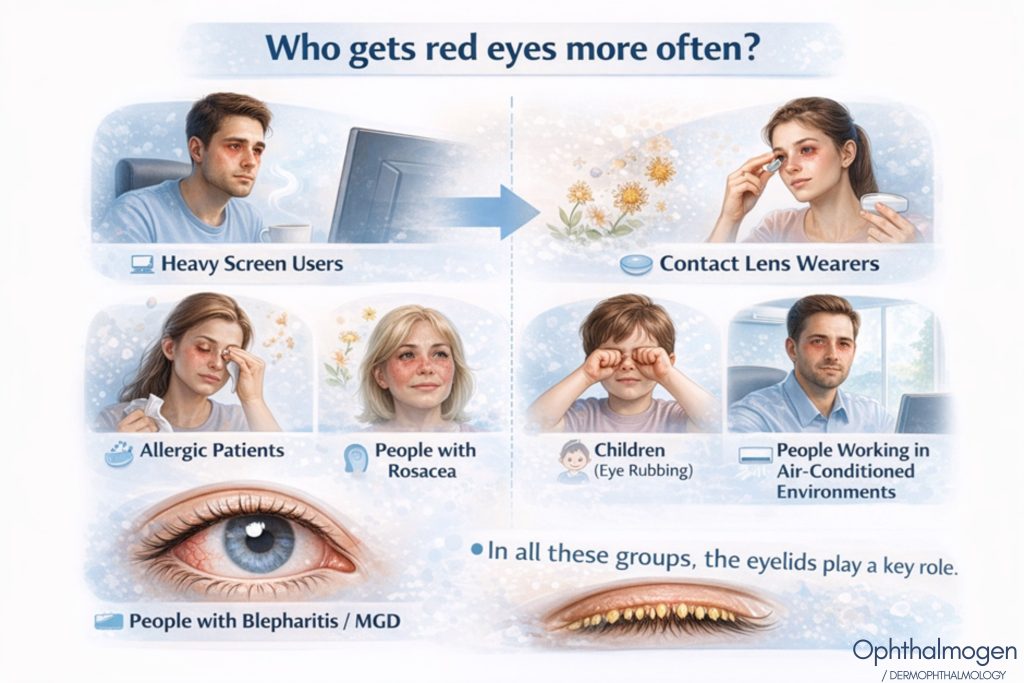
Who gets red eyes more often?
Higher-risk groups include:
- heavy screen users
- contact lens wearers
- allergic patients
- children (eye rubbing)
- people with rosacea
- people with blepharitis / MGD
- people working in air-conditioned environments
In all these groups, the eyelids play a key role.
Artificial tears: not all the same
People often look for:
- Visionlux Plus
- THEALOZ
- Systane
- Navitae Plus
And rightly so — because they can help..
Categories
Aqueous tears→ immediate hydration
Hyaluronic acid / trehalose-based→ longer duration, better comfort
Spray artificial tears→ applied from a distance→ even on open or closed eyes
Flora Vision Spray (red / for redness)
- suitable for red & irritated eyes
- natural extracts
- sodium hyaluronate
- sprayed directly onto the eye
Ideal for:
- children
- people who can’t tolerate drops
- frequent daytime use
However: artificial tears alone are not enough..
The role of artificial tears — and key differences
Artificial tears:
- hydrate
- dilute inflammatory factors
- improve comfort
They can be:
- aqueous
- hyaluronic acid-based
- lipid-enhanced
- sprays (for children & sensitive users)
They are essential, but:on their own, they do not restore lipid balance.
The eyelids: the true regulator of redness
The eyelids:
- produce the lipid layer
- determine how long tears “last”
- contact irritants daily (pollution, allergens, makeup)
When they don’t function well:
→ the eye becomes red
→ even if “there are tears”
Baudouin C. et al., The Ocular Surface
The modern framework (Dermophthalmology)
The solution is not: “whiten the eye”
The solution is: stabilize the system
Daily care framework
- Eyelid hygiene & support
- Improve lipid balance
- Targeted hydration
- Reduce allergic & inflammatory load
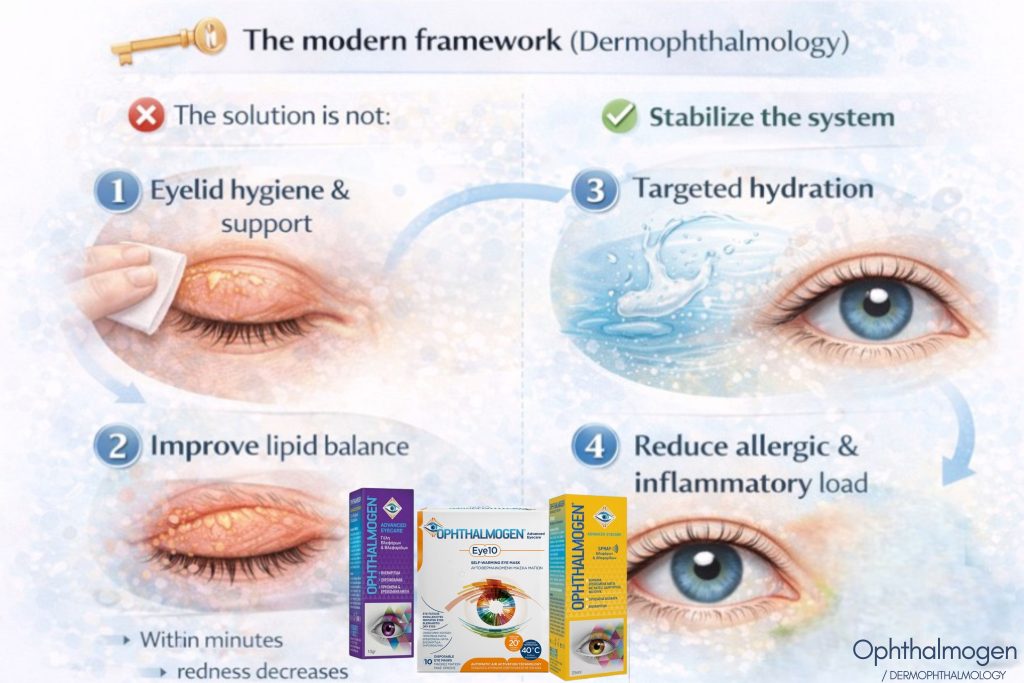
The role of the Ophthalmogen (the foundation of the solution)
The Ophthalmogen range is not vasoconstrictive.It does not “whiten” eyes in 5 minutes.It works at the root.
OphthalmogenEYE10 — Thermal decongestion
- 1–2 times/week
• liquefies meibum
• reduces evaporation
• improves tear film stability
Blackie CA et al., Cornea
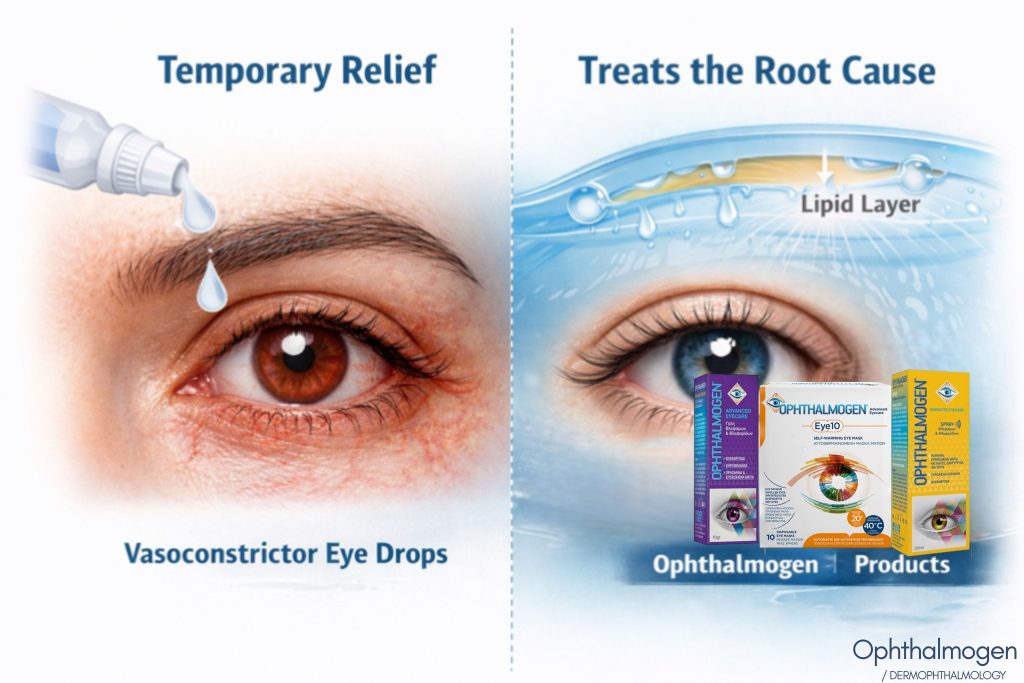
OphthalmogenGel — Eyelid massage
- daily or frequent use
• gentle massage
• reduces micro-inflammation
• helps prevent chronic redness
Bron AJ et al., Ocular Surface
Ophthalmogen Spray — Daily support
- used throughout the day
• on closed eyes
• ideal for allergic patients, children, and sensitive users
It does not replace eye drops — it complements them correctly.
FAQ — without confrontation
Should I stop vasoconstrictors suddenly?
Not abruptly. What’s needed is a change in strategy — not panic.
Can they ever be used?
Yes — rarely and occasionally. Correct use will not worsen the eye’s appearance.
Why are my eyes still red even though I use drops?
Because the problem is often in the eyelids.
In Summary
- Vasoconstrictors are not treatment
Redness is not the disease
Immediate whitening does not equal health
Tear film stability is the key
The eyelids are the regulator
Proper daily care changes the picture long-term
When we understand why eyes become red, we stop searching for ways to “whiten” them — and start focusing on keeping them truly healthy.