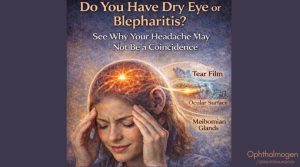

It is not a contradiction.It is not an exaggeration.And it is certainly not “normal.”
Introduction — When the Eyes Water, but Something Feels Wrong.
Many people describe the same paradox:
- their eyes water frequently
- they tear in wind, cold, or sunlight
- they tear during screen use
- they constantly need tissues
and at the same time:
- their eyes burn
- they sting
- they feel dry
- they fatigue easily
- symptoms worsen in the evening
The natural question is:How can an eye that produces tears still feel dry?The answer lies not in tear quantity,but in how the entire ocular system functions.
Not All Tears Are the Same.
Modern ophthalmology distinguishes between:
- functional tears, which protect and stabilize the ocular surface
- reflex tears, which are produced as a response to irritation
When the ocular surface becomes unstable, sensory nerves trigger reflex tearing.This is why there may be excess tearing, yet poor comfort.This mechanism is well documented in ophthalmic literature.
The Tear Film Is a System — Not a Drop.
The tear film consists of three functional layers:
- Lipid layer (produced by the Meibomian glands of the eyelids)
- Aqueous layer
- Mucin layer
The lipid layer:
- reduces evaporation
- stabilizes the tear film
- protects the cornea
When this layer fails, tears evaporate rapidly and the eye reacts with tearing.TFOS DEWS II Report (2017) defines dry eye disease as a multifactorial disorder of the ocular surface, with tear film instability at its core.

Why the Problem Often Starts in the Eyelids.
In a large proportion of patients, the problem is not insufficient tear production, but:
- eyelid dysfunction
- obstruction or underperformance of the Meibomian glands
- chronic eyelid margin inflammation
Nichols et al., The Ocular Surface showed that up to 70% of symptomatic patients with dryness have Meibomian Gland Dysfunction (MGD).
Knop et al., Progress in Retinal and Eye Research demonstrated that the eyelids are an active functional organ, essential for tear film stability and visual comfort.
The Role of Dermatology and Allergology.
The eyelid region:
- has the thinnest skin in the human body
- is richly innervated
- shows high immunological activity
Journal of Dermatology links seborrheic dermatitis, rosacea, and atopic skin conditions to chronic ocular irritation. Allergy & Clinical Immunology journals report that allergic eyelid inflammation can cause:
- tearing
- itching
- tear film instability
even in the absence of classic conjunctivitis.

Why Symptoms Worsen in the Evening.
The eye is an organ of endurance.During the day:
- blink rate decreases (especially during screen use)
- incomplete blinks increase
- Meibomian glands fail to drain effectively
Lemp et al. showed that tear evaporation significantly increases toward the end of the day.When compensatory mechanisms are exhausted, the eye responds with reflex tearing.
Why Artificial Tears Often Aren’t Enough on Their Own.
Artificial tears:
- provide hydration
- reduce friction
- are valuable for symptomatic relief
However: Studies in Clinical Ophthalmology demonstrate thatthey do not restore Meibomian gland function.
This is why many patients say:“I use drops, but the problem keeps coming back.”

The Dermophthalmology Perspective
Dermophthalmology approaches the eye as a single integrated functional system: eyelid skin – eyelids – eyelashes – glands – tear film
Not as isolated structures.Not as disconnected symptoms.

The Ophthalmogen— Translating Dermophthalmology into Daily Care
Dermophthalmology must translate into practical, daily action, especially at the point where instability begins: the eyelids.
The Ophthalmogen dermophthalmology line was developed with this exact principle in mind.Not to replace artificial tears.Not to “treat” symptoms.But to restore the biological conditions that allow tears to function properly.

STEP 1 — Thermal Support of Meibomian Glands.
Ophthalmogen EYE10
Controlled heat (~40°C) helps:
- liquefy thickened meibum
- facilitate gland expression
- improve the lipid layer of the tear film
- reduce evaporative stress
This step targets one of the primary mechanisms behind watery-yet-dry eyes.

STEP 2 — Functional Hygiene Changes.
Ophthalmogen Gel
Gentle daily eyelid cleansing:
- removes debris and biofilm
- reduces microbial load
- supports eyelid margin health
- helps normalize gland function
Without disrupting the delicate eyelid skin barrier.

STEP 3 — Daily Stabilization & Comfort.
Ophthalmogen Spray
Designed for:
- eyelid skin hydration
- microbiome support
- reduction of recurrent irritation
- comfort during screens, wind, and dry environments
How This Works Together with Artificial Tears
Artificial tears remain useful for short-term symptom relief.
However:
- drops support the surface
- eyelid care restores the system
Together, they form a complete modern approach, fully aligned with TFOS DEWS II principles.
When Improvement Typically Begins
Many patients report:
- reduced burning within days
- less tearing within 1–2 weeks
- improved evening comfort
- decreased dependence on drops
Stability builds progressively as eyelid function improves.
Frequently Asked Questions (FAQ)
Can eyes be dry and watery at the same time?
Yes. It is one of the most common and misunderstood ocular surface presentations.
Is this purely an allergy?
Allergy may contribute, but it is rarely the sole cause.
Are eye drops enough?
Usually not. Functional eyelid restoration is required.
Is this medical or cosmetic care?
It is functional, biology-based ocular surface care.
Is this lifelong treatment?
Not treatment — maintenance, similar to dental hygiene.
Final Message
If your eyes water but feel dry:
- it is not a contradiction
- it is not a personality trait
- it is not something you should accept
It is a message of functional instability.And today, thanks to modern ophthalmology, dermatology, allergology — and dermophthalmology —there is finally a clear explanation, a coherent framework, and a practical daily solution.Your eyes are not confused.They are communicating.And now, you know how to listen.