
Why Artificial Tears Are NOT Enough for Users antihistamine.
And how proper eyelid care truly changes the outcome
You take your antihistamine. Your allergy symptoms are under control. You use artificial tears. You feel relief — but only temporarily. Yet:
• your eyes remain red
• irritation keeps coming back
• eye fatigue persists
• sometimes your eyes water, sometimes they feel tight and dry
If this sounds familiar, you are not doing anything wrong. You are simply treating the symptom — not the root cause.
What artificial tears do (and what they don’t)
Artificial tears are a fundamental and necessary tool in daily eye care, especially for antihistamine users. Formulations such as:
Options such as:
• Visionlux Plus
• Visionlux Plus Duo
• THEALOZ Duo / THEALOZ Duo Gel
• Systane
• Navitae Plus
• Hylocomod, Hyabak, Vismed, Optive, HYLOPAN, Hylovet, Hylovet gel, Optive Plus, Eye Relax
• Artelac, Hylo Dual Intense, Wet tears, Optifresh, Wet Forte, Optonic, Cationorm, Bepanthene eye drops
• Corneregel, VitaPos, Tears Naturalle, Lactifresh, HYAL, HYE light, Tearprol, Refresh, Desodrop, Vidilac, Corneregel, Recugel, VITAPOS, Oftalia
• Flora Vision Spray
provide:
• immediate hydration of the ocular surface
• temporary symptom relief
• dilution of inflammatory mediators
However
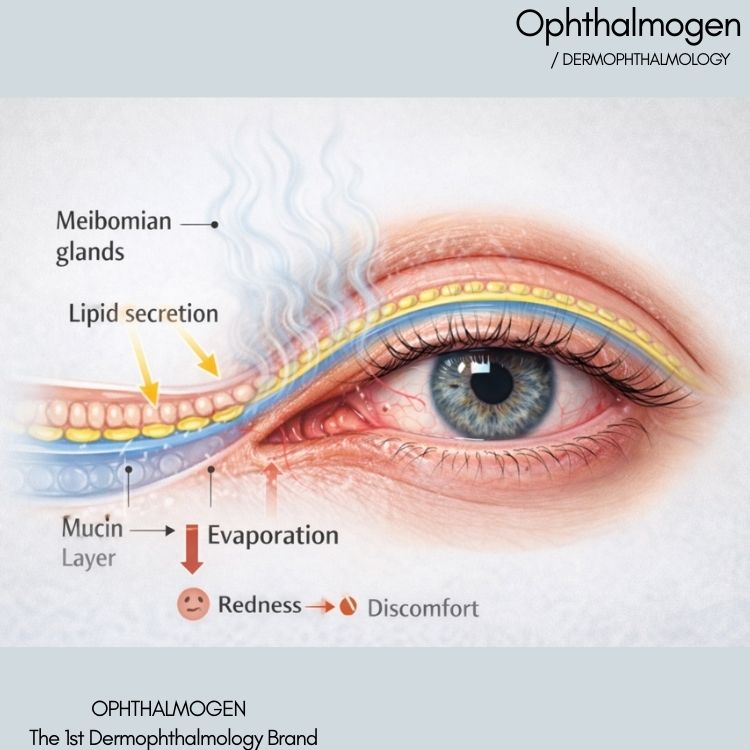
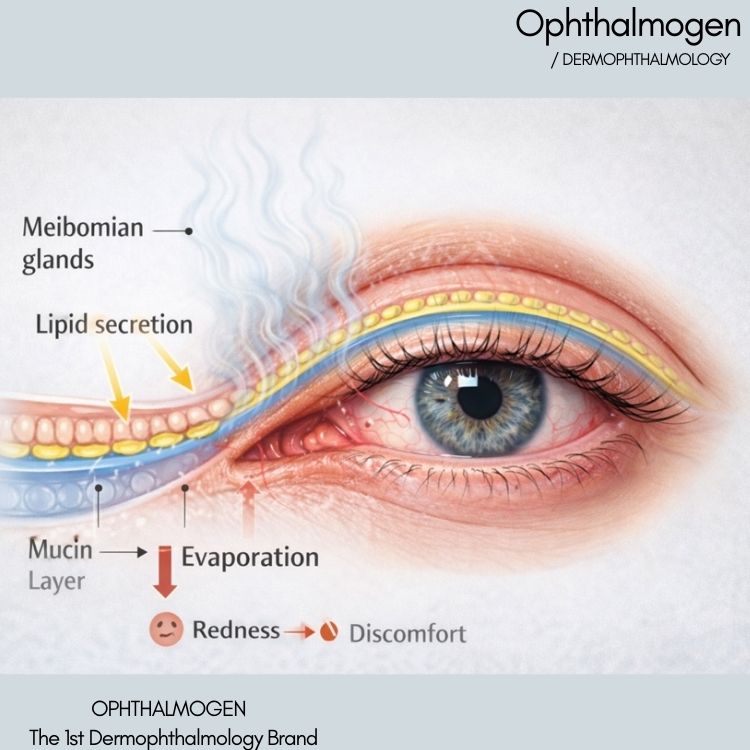
• they do not restore the lipid layer
• they do not reduce tear evaporation
• they do not improve eyelid or meibomian gland function
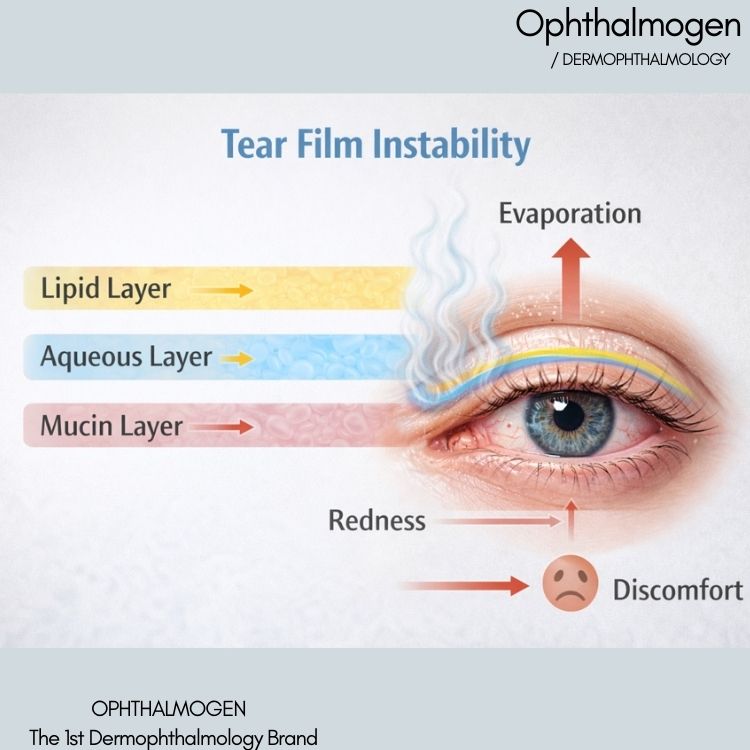
It’s not about “not having enough tears”
The international TFOS DEWS II consensus is clear: The most common cause of dryness and redness is not tear deficiency, but tear film instability. In most antihistamine users:
•tears are present
• but they evaporate too quickly
The role of the eyelids – the real regulator
Eyelids are not simply “skin around the eye.”
•they host the Meibomian glands
•produce the lipid layer of the tear film
• determine how long tears remain stable
When eyelid function is impaired:
• the tear film becomes unstable
•tears evaporate faster
•eyes become red, tired, and uncomfortable
Chronic ocular surface inflammation is sustained mainly by the eyelids, not by the eyeball itself.
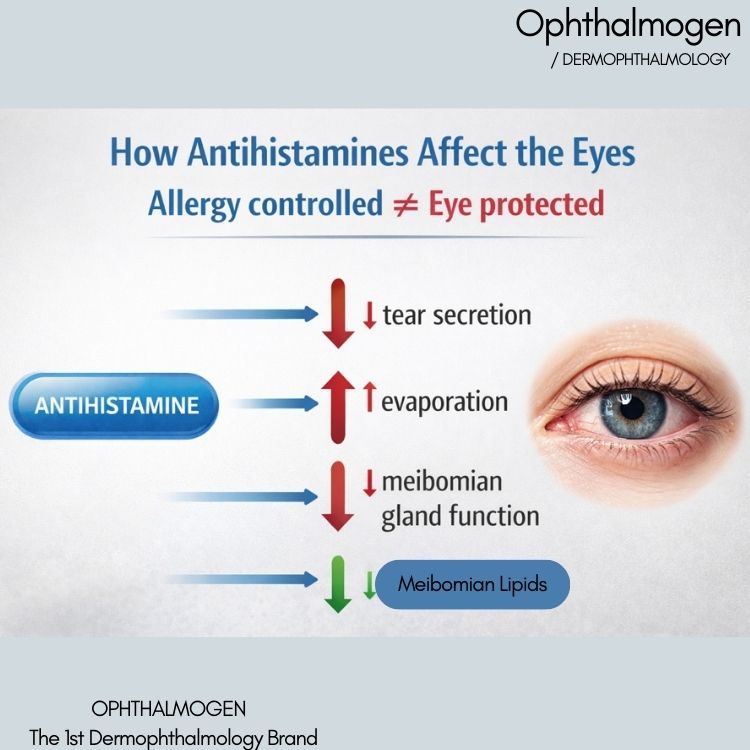
How antihistamines burden the system
Clinical studies demonstrate that antihistamines:
•reduce tear secretion
•increase tear evaporation
•impair Meibomian gland function
•worsen tear film instability
This explains why: allergy symptoms improve, but the eyes remain unprotected.
Why drops alone are not enough
Artificial tears act mainly on:
• the aqueous layer
They do not address:
•the eyelids
• lipid balance
• allergen load on the eyelashes
That is why relief often fades quickly. The first critical step: Eyelid cleansing Modern management of allergy-related eye discomfort starts at the eyelids.
Naviblef
– Control of allergen & microbial load
Naviblef Daily Care
• gentle daily eyelid hygiene
• prevention of flare-ups
• suitable for long-term use
Naviblef Intensive Care
• external use on eyelids only
• control of bacteria & Demodex
• use for up to 15 days
• avoid contact with the eye (may sting)
Where Ophthalmogen fits (logical sequence)
Ophthalmogen EYE10
• controlled thermal therapy
• activation of meibomian glands
• improvement of the lipid layer
• eyelid massage without rinsing
• ideal before bedtime
• natural composition
• suitable for long-term use
Ophthalmogen Spray
• application on closed eyes
• immediate soothing effect
• ideal for work, travel & allergy flare-ups
The smart strategy
• - Antihistamine → allergy control
- Eyelid cleansing (Naviblef) → reduction of allergen load
- Ophthalmogen → stability, hygiene & prevention
- Artificial tears → immediate hydration
Integration, not replacement.
FAQ – Frequently Asked Questions
Are artificial tears useless?
No. They are helpful — but often not enough on their own.
Can I combine all of these daily?
Yes. Each step targets a different mechanism.
Will this help long-term?
Yes, because the cause is finally addressed — not just the symptoms.
In Summary
• Τα Antihistamines are not “bad”
• Artificial tears alone are not enough
• Eyelid care changes the outcome
• Quality of life can improve significantly