

Why allergies make contact lenses harder to tolerate — and what really helps
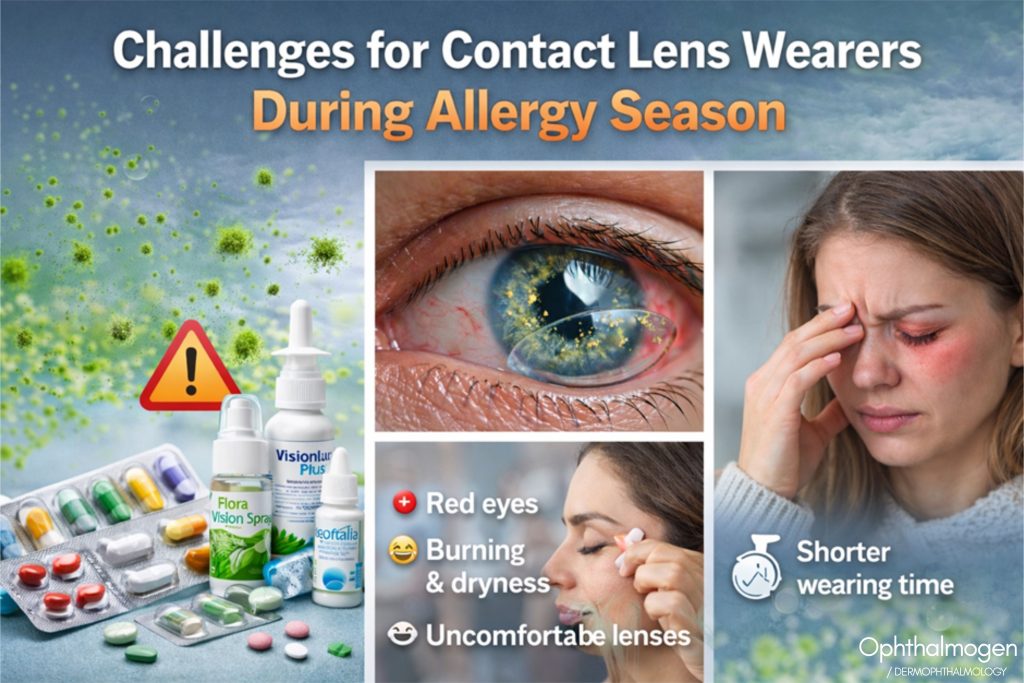
Contact lenses offer freedom.Allergies, however… do not.For thousands of people, spring and allergy season mean:
- red eyes
- burning and dryness
- contact lens intolerance
- fewer comfortable wearing hours
And often, even though:
- allergies are “controlled” with antihistamines
- artificial tears are being used
contact lenses remain uncomfortable.If this sounds familiar, you are not alone — and you are not doing anything wrong.
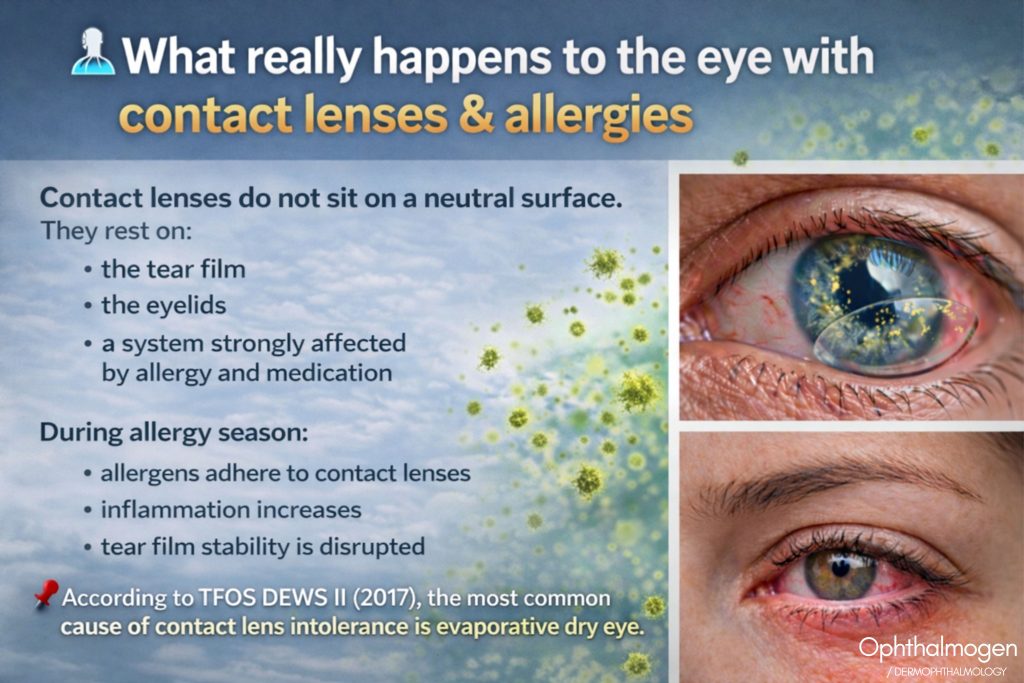
What really happens to the eye with contact lenses & allergies
Contact lenses do not sit on a neutral surface.
- the tear film
- the eyelids
- a system strongly affected by allergy and medication
During allergy season:
- allergens adhere to contact lenses
- inflammation increases
- tear film stability is disrupted
According to TFOS DEWS II (2017), the most common cause of contact lens intolerance is evaporative dry eye, not insufficient tear production.
Antihistamines: essential — but not neutral for contact lenses
Antihistamines are indispensable for:
- allergic rhinitis
- asthma
- seasonal allergies
However, they also affect:
- tear secretion
- eyelid function
- tear film stability
Clinical studies show that antihistamines:
- reduce baseline lubrication
- increase tear evaporation
- worsen contact lens intolerance
Ousler GW et al., Clinical Therapeutics
Abelson MB et al., Survey of Ophthalmology
In many cases, contact lens intolerance is related to dry eyes that antihistamines can cause — read more here.
This explains why eyes fatigue faster when contact lenses and antihistamines are combined.
Different lenses — different behavior during allergy season
Soft hydrogel lenses
- absorb allergens
- accumulate protein deposits
- often feel “heavy” in spring
Silicone hydrogel lenses
(Acuvue Oasys, Air Optix Aqua, Biofinity)
- improved oxygen transmission
- not necessarily better comfort if eyelids are dysfunctional
Daily disposable lenses
(Dailies Total1, Acuvue Oasys 1-Day, MyDay)
- generally better tolerated during allergy season
- but they do not solve the problem on their own
If eyelid function is compromised, no lens type can fully compensate..

Hydration WHILE wearing contact lenses: essential
Daytime hydration is fundamental for lens wearers.
- Flora Vision Spray→ sprayed on open eyes, without removing contact lenses
- Visionlux Plus
- Oftalia
Visionlux Plus is considered by many users to be among the most hydrating artificial tears, while Flora Vision Spray allows hydration without interrupting lens wear.
- hydration alone is not enough if the eyelids are blocked or inflamed.
The real regulator of contact lens comfort: the eyelids
The eyelids:
- regulate the lipid layer
- low-grade inflammation
- meibomian gland dysfunction
Baudouin C. et al., The Ocular Surface
When there is:
- allergic blepharitis
- low-grade inflammation
- meibomian gland dysfunction
dry eye, irritation, blurred vision, and reduced lens tolerance gradually develop.
Eyelid massage AFTER lens removal (crucial step).
After removing contact lenses, eyelid massage with Ophthalmogen Gel is a key step for chronic contact lens wearers, because it:
- prevents meibomian gland blockage
- reduces inflammation
- improves meibum flow
- protects against long-term dry eye
This is one of the most underestimated yet critical steps for long-term contact lens tolerance.
Thermal decompression at least once per week.
Using Ophthalmogen EYE10:
- provides controlled heat
- liquefies thickened meibum
- prevents contact lens intolerance
- improves tear film stability
At least once per week is recommended for contact lens wearers.
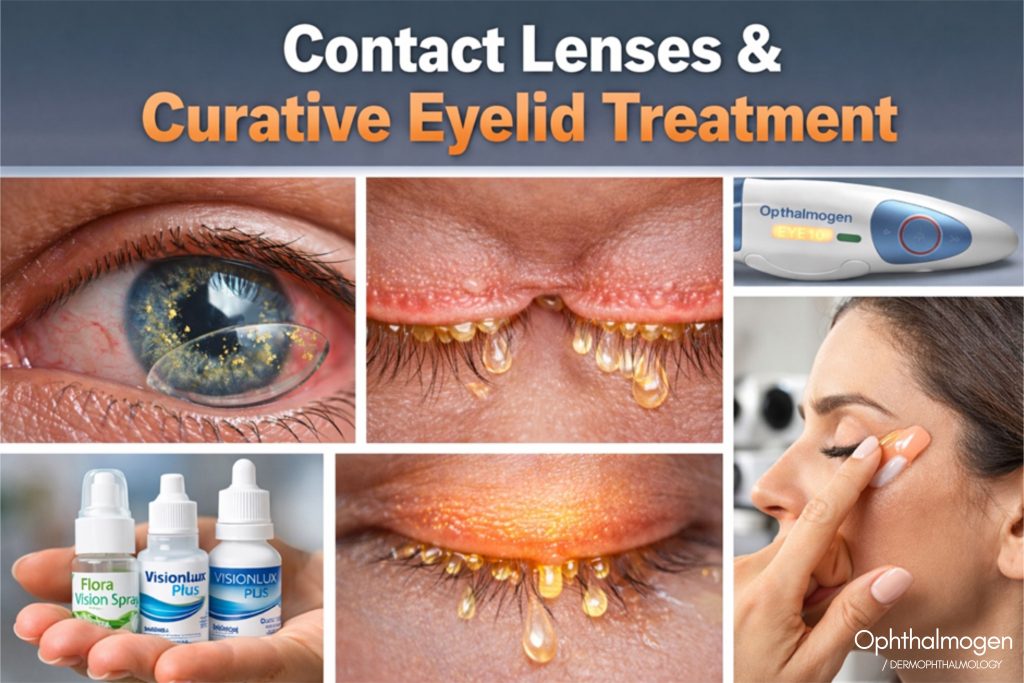
The integrated strategy for contact lenses & allergies.
Antihistamines → allergy control
Hydration during lens wear → Flora Vision Spray, Visionlux Plus, Oftalia
Eyelid massage after lens removal → Ophthalmogen Gel
Thermal decompression once weekly → Ophthalmogen EYE10
Proper lens selection → fewer deposits
Collaboration of mechanisms — not a “one product fits all” approach.
FAQ — Frequently Asked Questions
Is eyelid massage really necessary?
Yes. It is essential for preventing gland obstruction.
Are artificial tears enough?
Not on their own. Eyelid-centered care is also required.
Should I stop wearing contact lenses in spring?
Not necessarily. Many people continue comfortably with proper support.
Conclusion
- Contact lenses are not the problem
- Antihistamines are not the enemy
- Eye drops alone are not enough
- Eyelids are the key regulator of comfort
- Massage and decompression make a real difference
Contact lenses can be worn comfortably — even during allergy season — when the eye is treated as a unified, eyelid-centered system.
If symptoms persist despite changing lenses or eye drops, it is worth considering the role of antihistamines in tear function. Learn more here.


