
(The complete Dermophthalmology Guide)
Could the Problem Start from the Eyelids?If you feel stinging in your eyes, itching, or wake up with sticky discharge, you’re not alone.Thousands of people search every day to understand what eye stinging really means and why it persists—even when they are already using eye drops.The answer is often not inside the eye itself, but on the eyelids.
What Does Eye Stinging Really Mean?
Eye stinging is not a diagnosis.It is a symptom.It is commonly accompanied by:
- itching
- burning sensation
- sticky feeling
- discharge in the morning
- Redness,
- tearing that… doesn’t actually relieve discomfort
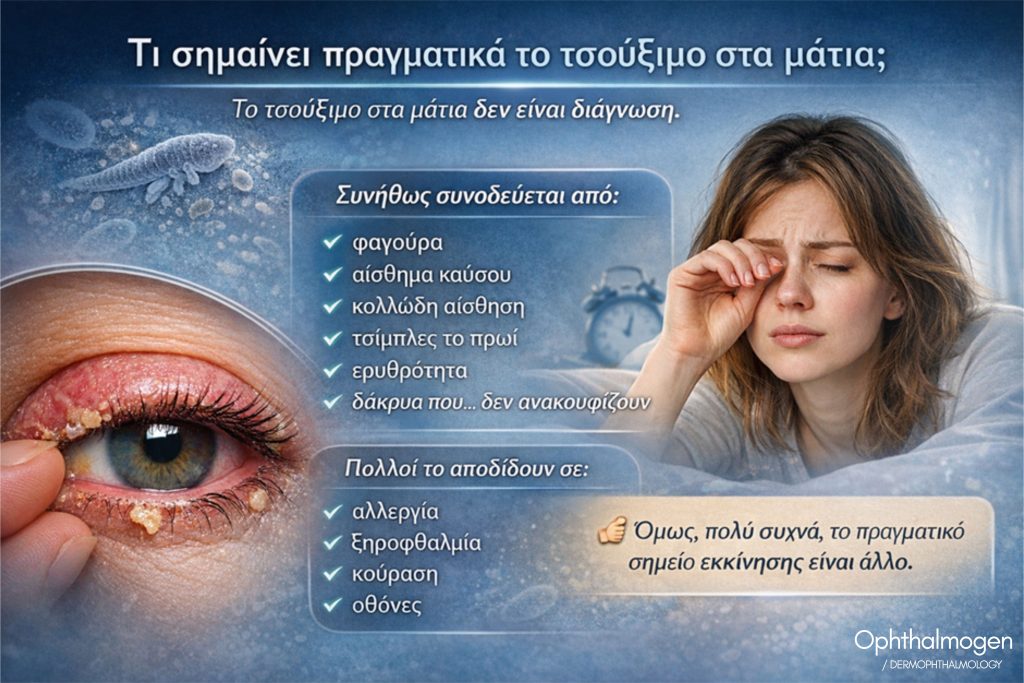
Many people attribute it to:
- allergies
- Dry eye
- fatigue
- screen use
However, very often, the real starting point lies elsewhere.

The Hidden Source of the Problem: The Eyelids
Eyelids are not just “skin around the eye.”The eyelids:
- are skin
- host the eyelashes
- contain the meibomian glands
- come into daily contact with microbes, pollution, and makeup
- regulate tear quality
When the eyelids are not clean or not functioning properly:
- tear film stability is compromised
- inflammation increases
- stinging, itching, and discharge appear
Why Is Eye Stinging Worse in the Morning?
During the night it:
- the eyelids remain closed
- the meibomian glands do not drain
- the lipid secretion becomes thicker
- bacteria and Demodex remain at the lash base
That’s why:
- you wake up with stinging
- you notice discharge
- your eyes feel “heavy”
- your vision needs time to clear

Why Eye Drops Are Often Not Enough
Most eye drops:
- provide temporary hydration
- do not act on the eyelids
- do not clean the lash base
- do not unblock the glands
If stinging originates from the eyelids,no eye drop alone can solve the problem.
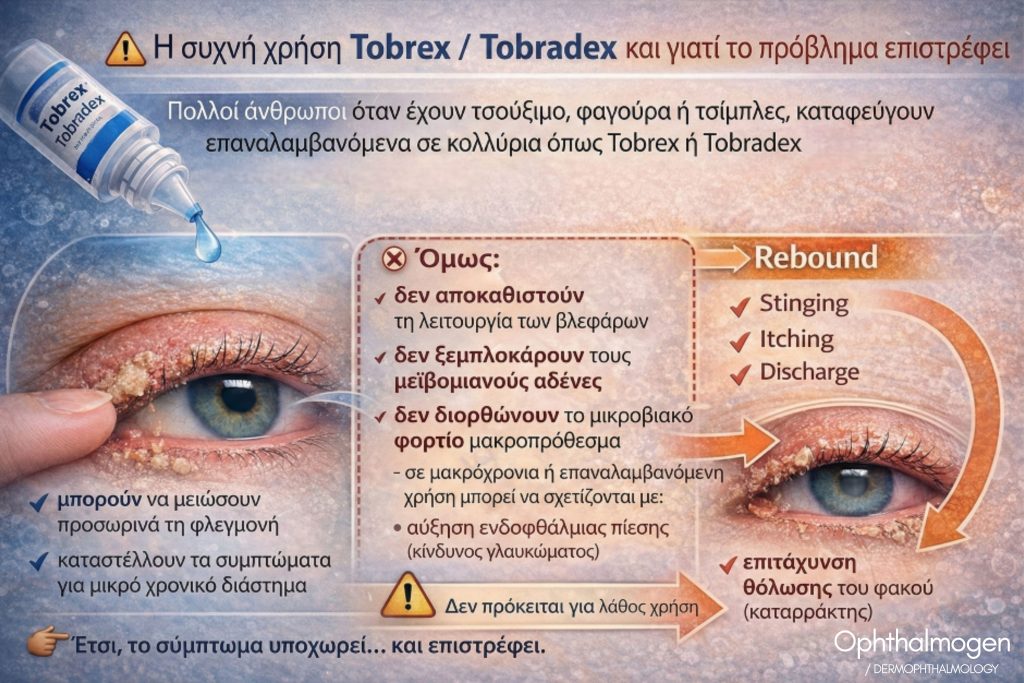
Frequent Use of Tobrex / Tobradex — and Why Symptoms Return
Many people repeatedly use eye drops such as Tobrex or Tobradex for stinging, itching, or discharge—often because they once “worked.”These drops:
- may temporarily reduce inflammation
- suppress symptoms for a short time
However:
- they do not restore eyelid function
- do not unblock the meibomian glands
- they do not restore eyelid function
- with long-term or repeated use, they may be associated with:
- increased intraocular pressure (risk of glaucoma)
- accelerated lens opacity (cataract formation)
As a result, symptoms improve… and then return.This is not “wrong use.”It is the wrong target.
What Happens When Blepharitis or Demodex Is Demodex mites;
In many cases of persistent stinging, there is coexistence of:
- blepharitis
- increased bacterial load
- Demodex at the base of the eyelashes
This leads to:
- chronic inflammation
- itching
- discharge
- burning
- a sensation of “dirty eyes”
And this is often not easily visible during routine examinations.
The Dermophthalmology Approach: Start with the Eyelids
Modern Dermophthalmology views the eye as an interface system:
- eyelids
- eyelashes
- skin
- glands
- tear film
The solution to eye stinging is not another eye drop, but:daily eyelid hygiene.

How the Ophthalmogen Protocol Helps
Step 1 — Ophthalmogen EYE10 (Heat)
Self-heating compresses:
- liquefy thickened lipid secretions
- open the meibomian glands
- helps control inflammation
- improve tear quality
This significantly reduces morning stinging.
Step 2 — Ophthalmogen Gel & Spray
After heat:
- the Gel allows gentle eyelid massage
- cleans the eyelash base
- reduces bacteria & Demodex
- the Spray supports comfort throughout the day
It doesn’t “burn” the eye — it restores balance.
What changes in real life?
People with chronic eye stinging report:
- less burning
- less itching
- fewer secretions
- clearer vision
- reduced need for eye drops
Eye drops remain helpful,but they are no longer the foundation.
Conclusion
Eye stinging is not normal.It is not always allergy or “just dry eye.”Very often, it starts at the eyelids.And it resolves only when hygiene becomes part of the solution.If you experience stinging, itching, or morning discharge:Don’t just add more drops.Start where the problem begins — the eyelids.
FAQ — Τσούξιμο, φαγούρα & τσίμπλες στα μάτια
What does eye stinging mean?
It is a symptom of ocular surface irritation, often related to tear film instability and eyelid dysfunction.
Why do my eyes sting in the morning?
Because of thickened lipid secretions, reduced gland drainage, and the presence of bacteria or Demodex overnight.
What do stinging and discharge in the morning indicate?
Συχνά δείχνουν βλεφαρίτιδα ή φλεγμονή στη βάση των βλεφαρίδων.
4) Είναι ξηροφθαλμία ή αλλεργία;
Μπορεί να είναι και τα δύο και συχνά συνυπάρχουν.
5) Γιατί χειροτερεύει το τσούξιμο μέσα στη μέρα;
Λόγω οθονών, μειωμένου βλεφαρισμού, ξηρού αέρα και αυξημένης εξάτμισης δακρύων.
6) Γιατί τα κολλύρια δεν κρατάνε;
Επειδή δεν διορθώνουν την αιτία όταν αυτή βρίσκεται στα βλέφαρα.
7) Μπορούν τα βλέφαρα να προκαλούν τσούξιμο;
Ναι. Ρυθμίζουν τη λιπιδική στιβάδα και τη σταθερότητα των δακρύων.
8) Τι ρόλο παίζει το Demodex mites;
Μπορεί να ενισχύει τη βλεφαρίτιδα και να προκαλεί φαγούρα, τσούξιμο και τσίμπλες.
9) Τι μπορώ να κάνω πρακτικά;
Καθημερινή ρουτίνα:
- θερμότητα (Ophthalmogen EYE10)
- ήπιο μασάζ & καθαρισμός (Ophthalmogen Gel)
- υποστήριξη μέσα στη μέρα (Ophthalmogen Spray)
10) Πότε χρειάζεται άμεσα οφθαλμίατρος;
Σε έντονο πόνο, φωτοφοβία, απότομη μείωση όρασης ή πυώδες έκκριμα.
11) Είναι φυσιολογικό το τσούξιμο με φακούς επαφής;
Όχι. Συχνά δείχνει αστάθεια της οφθαλμικής επιφάνειας.
12) Τι είναι η Δερμοφθαλμολογική προσέγγιση;
Η θεώρηση του ματιού ως σύστημα διεπιφάνειας (βλέφαρα–δέρμα–αδένες–δάκρυα), όπου η υγιεινή είναι βασική θεραπευτική πράξη.