
What is really happening — and what parents can safely do.
Many parents hear the same sentence again and again:“It’s not conjunctivitis.”
And yet, the child:
- wakes up with red eyes
- rubs their eyes frequently
- shows morning redness
- complains of stinging, burning, or heaviness
- gets tired easily at school or during screen use
And parents are left with the same question:“If it’s not an infection, then what is it?”
Red eyes in children ≠ always conjunctivitis
When there is no:
- purulent discharge
- severe pain
- photophobia
- fever or acute worsening
then redness is rarely caused by conjunctivitis.
In most cases, it is associated with:
- blepharitis
- poor eyelash and eyelid hygiene
- Demodex (very common and underdiagnosed in children)
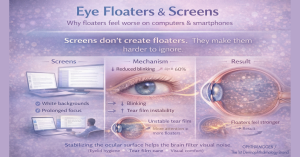
- screens & reduced blinking
- tear film instability
Simply put: the problem starts at the eyelids.
What scientific studies show (pediatric data)
Pediatric Ophthalmology
- Demodex blepharitis in children – British Journal of Ophthalmology
➜Demodex is frequently detected in children with:
- chronic redness
- frequent eye rubbing
- morning symptoms
- Blepharitis in children – American Journal of Ophthalmology
➜ Blepharitis is one of the most common causes of red eyes without infection in children.
Screens & school age

- Digital eye strain in children – Ophthalmology
➜ Reduced blinking → tear film instability → redness.
More than 50% of school-aged children show symptoms of ocular fatigue.
TFOS DEWS II (also applies to children)
➜ Evaporative dry eye, caused by eyelid dysfunction, is a more frequent cause of redness than lack of tear production.
Why eye drops are not the solution for children
Most parents:
- worry about frequent eye-drop use
- struggle to instill drops
- prefer a gentle, non-pharmaceutical approach
And they are right.Eye drops:
- offer temporary relief
- do not reduce microbial load
- do not clean the eyelids
- do not address Demodex
- do not stabilize the tear film
That’s why the problem keeps coming back.
Eyelid hygiene must be taught from early childhood
Parents teach children:
- to wash their hands
- to care for their body and face
- to brush their teeth
- to maintain oral hygiene
But something is missing from this basic “hygiene education”:eye and eyelid hygiene.
And yet, the eyelids:
- protect the eyes
- regulate tear quality
- directly affect visual comfort
- play a key role in visual quality and concentration
Just as we don’t wait for cavities to teach children to brush their teeth,we should not wait for red eyes to care for the eyelids.

Eyelid hygiene should become part of:
- daily routine
- basic hygiene education
- basic hygiene education
just like hand- and face-washing.
The foundation of healthy eyes in children: Eyelid hygiene
Modern pediatric ophthalmology is clear:Fewer medications.More eyelid care. Περισσότερη φροντίδα στα βλέφαρα.
The gentle pediatric Ophthalmogen protocol

Ophthalmogen Gel — The foundation of daily care
- safe for pediatric use
- applied on closed eyes
- gentle eyelid massage
- cleanses the eyelash base
- reduces microbial load &Demodex
- improves tear film quality
- reduces itching
Ideal for:
- children who rub their eyes
- morning redness
- recurrent “red eyes without infection”

Ophthalmogen Spray — Easy daytime support
- spraying on closed eyes
- no drops
- no stress
- ideal for school & activities
Perfect for children who do not cooperate with eye drops.
Flora Vision Spray — Next-generation artificial tears for children
- the first artificial tears in spray form
- sprayed from a distance onto open eyes
- no “eye-drop experience”
- ideal for hydration & avoiding medicated drops
- reduces dryness & redness
In many cases, it can replace classic eye drops.
What changes in real life
Parents report:
- less eye rubbing
- less morning redness
- calmer eyes at school
- fewer visits for “red eyes”
- better quality of life for the child
- less irritability and complaints

Conclusion for parents
- Red eyes do not always mean infection
- Eye drops are not always necessary
- The issue often starts at the eyelids
- Eyelid hygiene is a safe, gentle solution
- Children cooperate better with gel & spray
- Prevention reduces recurrences
- Less fear
- More care
- Children’s eyes that can handle daily life
FAQ — Red eyes in children
- Are Ophthalmogen products safe for children?
Yes. They are gentle, non-pharmaceutical, and suitable for pediatric use.
- If it’s not conjunctivitis, what is it?
Often blepharitis or tear film instability.
- Are eye drops always necessary?
No. Proper eyelid hygiene is often sufficient.
- What if the child does not cooperate?
Το Ophthalmogen Spray και το Flora Vision Spray είναι ιδανικά χωρίς πίεση.
- When is an ophthalmologist needed?
In cases of pain, photophobia, discharge, or worsening symptoms.