

Screens, Digital Eye Strain, and Why Floaters Appear More Noticeable on Computers and Smartphones
Many people notice thateye floaters):
- appear more prominent after long hours in front of screens
- become especially disturbing on white backgrounds (emails, documents, browsers)
- bother them more at the office or on their phone than outdoors
This naturally leads to the question: “Do screens cause eye floaters?” The answer is not directly. However, the relationship between screen use and floaters is very close—and fully explainable by science.
Screens Do Not Create Floaters — But They Change How We Perceive Them
Eye floaters originate in the vitreous body, not from screens.
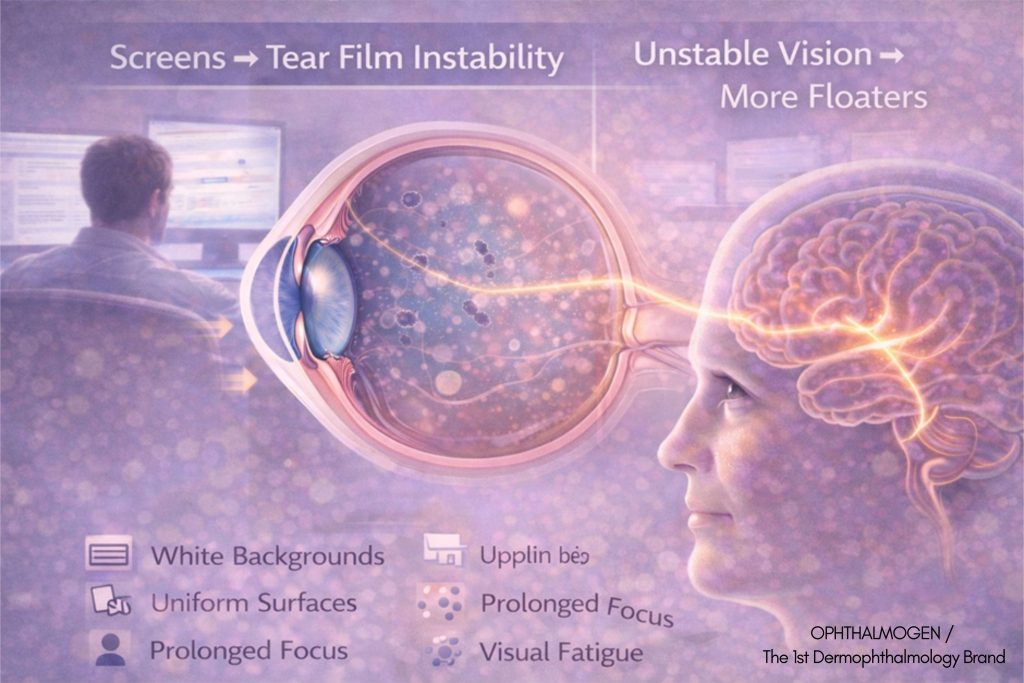
However, prolonged use of digital devices::
- reduces blink rate
- destabilizes the tear film
- overloads the visual system
- increases cognitive and visual hyperfocus
These factors do not increase floaters, but they make them more visible and more disturbing.
Why Floaters Look Worse on Screens
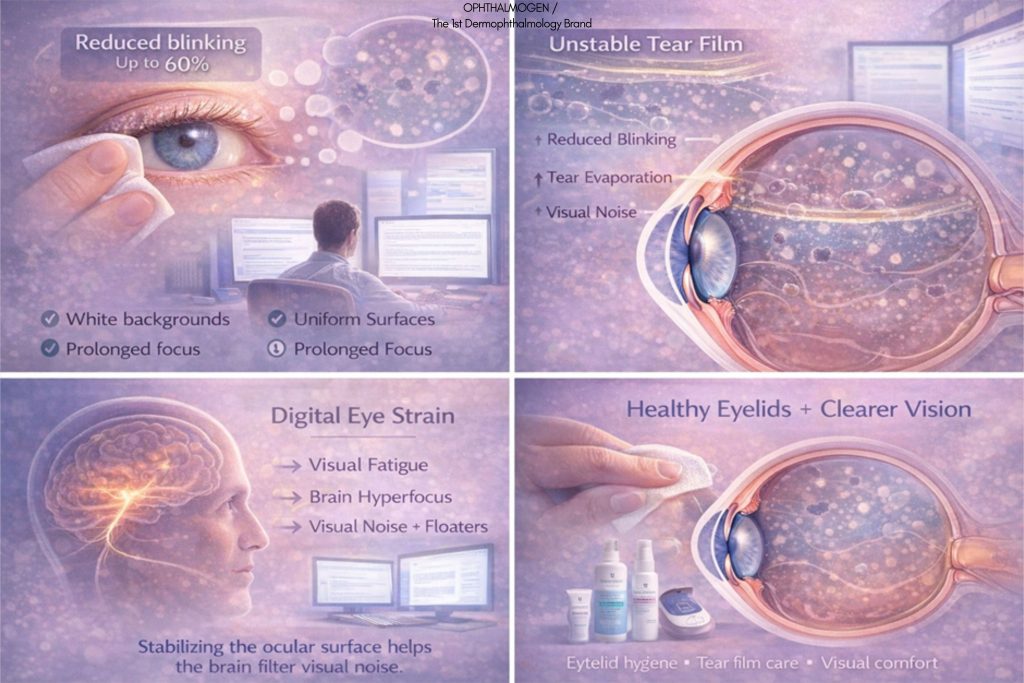
Uniform, Bright Backgrounds
Floaters are easier to notice::
- on white surfaces
- on uniform backgrounds
- at high brightness levels
Exactly the visual conditions created by digital screens.
Blink Rate Reduction (Up to 60%)
Studies show that during screen use:
- blinking frequency drops significantly
- the tear film breaks up faster
- the surface becomes irregular
When the image is unstable, every shadow—every floater—becomes more noticeable.
Digital Eye Strain & Cognitive Hyperfocus
Sustained concentration:
- overloads the visual system
- increases neural alertness
- reduces natural visual relaxation
The brain starts “scanning” the image and fixates more on visual imperfections.
What Is Digital Eye Strain?
Digital eye strain is not a disease, but a cluster of symptoms including::
- fluctuating or blurred vision
- eye heaviness or burning
- dryness or reflex tearing
- headache
- difficulty focusing
In this context: floaters do not increase, but they become more dominant in perception.
Scientific Background — What the Evidence Shows
Reduced Blinking & Tear Film Instability:
Tsubota & Nakamori – American Journal of Ophthalmology: Screen work significantly reduces blink rate, leading to tear film instability.
Digital Eye Strain & visual discomfort
Sheppard & Wolffsohn – BMJ Open Ophthalmology: Digital eye strain increases neuro-visual discomfort and conscious symptom awareness.
Tear film stability & visual quality
TFOS DEWS II Report – The Ocular Surface: Tear film instability degrades image quality and increases visual “noise.”
When the image becomes unstable, the brain struggles to ignore floaters.
Why Eyelid Hygiene Is Especially Important for Screen Users
People who spend long hours on screens more frequently develop::
- meibomian gland dysfunction
- lipid layer instability
- increased tear evaporation
Proper eyelid hygiene::
- cleans the optical surface
- supports the lipid layer of the tear film
- stabilizes visual input
As visual “noise” decreases, floaters lose their perceptual dominance.
Practical Daily Support with Ophthalmogen (Realistic & Scientifically Grounded)
Important: Ophthalmogen products do not change the vitreous and do not eliminate floaters.They improve the visual environment through which the image passes.
Evening — Ophthalmogen EYE10
- gentle warmth
- supports meibum fluidity
- improves eyelid function
Morning — Ophthalmogen Gel
- eyelid margin cleansing
- removes debris that destabilizes vision
During the Day — Ophthalmogen Spray
- hydration during screen use & air conditioning
- comfort without interrupting work
Goal: more stable vision → less fixation on floaters
Practical Tips for People Who Notice Floaters on Screens
- follow the 20-20-20 rule
- blink consciously
- maintain daily eyelid hygiene
- support ocular surface stability
- avoid obsessive symptom monitoring
FAQ – Frequently Asked Questions (Schema-Ready)
Do screens cause eye floaters?
No. They make existing floaters more noticeable.
Why do I mainly see floaters on my computer;
Because of white backgrounds, eye fatigue, and tear film instability.
Does eyelid hygiene really help?
Yes. It stabilizes vision and reduces visual discomfort.
Do Ophthalmogen products remove floaters?
No. They reduce visual instability that amplifies them.
When should I seek eye examination?
If floaters suddenly increase, flashes appear, or vision loss occurs.
Conclusion
Screens do not create eye floaters—but they create the perfect conditions for floaters to become more disturbing.Digital eye strain, tear film instability, and inadequate eyelid hygiene increase visual discomfort and symptom awareness.Proper ocular surface care and balanced screen use can significantly improve daily visual comfort and quality of life.
Disclaimer: This article is for informational purposes only and does not replace a professional eye examination.