Introduction

Dry eye disease and blepharitis are often treated as separate conditions.

In reality, they are closely interconnected:

  • Blepharitis triggers inflammation and blocks the meibomian glands.
  • This leads to poor tear quality and increased evaporation.
  • The result: dry eye symptoms such as burning, tearing, and blurry vision.

Just like a coin has two sides, these two conditions are in fact one unified problem.

The Pathophysiology Behind the Link

  • Meibomian glands secrete lipids that stabilize the tear film.
  • When inflammation from blepharitis blocks them → the lipid layer collapses.
  • The tear film becomes unstable → tears evaporate → dry eye.
  • Dry eye then worsens inflammation → creating a vicious cycle.

Symptoms That Show the Connection

  • Red, tired eyes.
  • Foreign body sensation.
  • Constant tearing (paradoxical sign of dry eye).
  • Itching, burning.
  • Blurred vision at the end of the day.
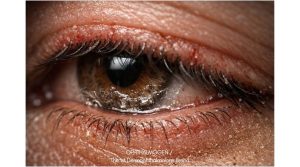
  • Dandruff-like flakes or excess oil on the lashes (sign of blepharitis).

In fact, when we see dry eye, 70% of cases are due to meibomian gland dysfunction (MGD) that originates in blepharitis.

Epidemiology

  • Up to 50% of the global population reports dry eye symptoms.
  • 37–47% of patients examined by ophthalmologists present with blepharitis.
  • 50% of dry eye patients also suffer from anterior blepharitis.

The aesthetic dimension

Chronic blepharitis and dry eye don’t only affect vision:

  • They contribute to dark circles.
  • They are linked to early eyelid drooping (ptosis).
  • They make the eyes look tired, dull, and prematurely aged.

This is why Dermophthalmology views the eyes not only as organs of vision, but also as an aesthetic unit.

The Role of Demodex

The Demodex mite:

  • Colonizes eyelash follicles.
  • Clogs glands and worsens inflammation.
  • Is responsible for 65% of blepharitis cases.

Therefore, many dry eye cases have a hidden cause: Demodex infestation.

The Dermophthalmology Solution

Treatment is not about “just an eye drop.” It requires a holistic daily routine:

  • Ophthalmogen & Naviblef cleansing → removes sebum, flakes, microbes.
  • Ophthalmogen Spray → controls Demodex and bacteria.
  • Ophthalmogen EYE10 thermal therapy → unclogs meibomian glands, stabilizes the tear film.
  • Ophthalmogen Gel massage → improves circulation, reduces inflammation.
  • Complementary use of high-performance artificial tears (Visionlux Plus Duo, Thealoz Duo, Navitae Plus, Systane, Oftalia Naturando, Artelac, Flora Vision Spray)
  • Vitamin & Omega-3 supplements ALLVITA EYES capsules → enhance tear quality.

This routine effectively breaks the vicious cycle of blepharitis and dry eye.

Conclusion

Blepharitis and dry eye are not two separate diseases; they are two sides of the same coin. Dermophthalmology teaches us that the real solution lies in daily eyelid hygiene.That’s how eyes remain clean, comfortable, and radiant – both in function and in appearance.

Recommended Posts