
From the first symptoms to daily hygiene
Introduction
Dry eye disease affects millions of people worldwide, yet it is often treated as a minor inconvenience.
“It will go away with a few Artificial tears,many think."
The truth is different:dry eye is a chronic, multifactorial disease that impacts not only comfort, but also the quality of vision and the appearance of the eyes.

Dermophthalmology shifts the perspective: it brings prevention into the spotlight as the most effective and economical pathway to healthy, comfortable, and radiant eyes.
Prevention in Medicine: A Historical Lesson

The value of prevention has been proven across medicine::
- Cardiovascular disease → diet, exercise, and blood pressure control prevent heart attacks.
- Oncology → screening (e.g., mammography, colonoscopy) saves lives.
- Dentistry → daily brushing and flossing drastically reduced cavities and periodontal disease.
For most people, prevention is deeply imprinted in the subconscious as a fundamental health principle.Yet in the field of eye health and vision, prevention has not been equally emphasized.
This is the gap Dermophthalmology seeks to fill.
The Eyes: Unique and Irreplaceable
Ophthalmology has achieved extraordinary technological progress::
- refractive lasers,
- contact lenses,
- intraocular lenses,,
- advanced microsurgery.
But unlike Dentistry, the eye cannot be replaced..
- Teeth can be substituted with dentures, bridges, implants.
- Eyes cannot be “implanted” or replaced with an artificial organ that restores vision.
Ocular transplantation is limited to the cornea, and experimental approaches with retinal implants are still far from restoring natural vision. There is no full eye replacement available (Carrenoetal., 2021, Nature Biomedical Engineering).

This means that the eyes we are born with are the ones we carry for life.
Prevention and daily care are not optional—they are essential..
The Paradox of Dry Eye

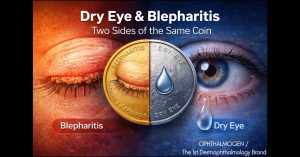
- The medical community recognizes dry eye as a chronic, inflammatory, multifactorial disease (TFOS DEWS II, 2017).TFOS DEWS II, 2017).
- The public, however, often perceives it as a temporary irritation.
Artificial tears provide momentary relief, but they are only “painkiller” of dry eye — they do not cure it, nor do they stabilize the tear film.

Prevention and daily hygiene are the missing keys.
The Four Pillars of Prevention in Dermophthalmology

- Thermal therapy &meibomian gland expression → restores lipid layer balance, prevents dry eye and blepharitis.
- Eyelid cleansing → removes microbial and lipid load, regulates Demodex.
- Massage & microcirculation → reduces congestion, inflammation, and improves periocular appearance.
- Sprays & hydration → stabilize the tear film and protect against environmental triggers.
What Happens Without Prevention?

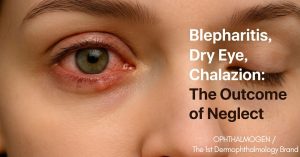
Neglecting eye hygiene leads to chronic tear film instability. This affects not only comfort but also vision and appearance:
- Vision: blurred and fluctuating sight, difficulty reading, unstable night driving. Unstable vision also causes reduced attention and concentration, impairing work performance and daily activities.
- Comfort: persistent burning, paradoxical tearing, foreign body sensation.
- Appearance: red eyes, swollen lids, dark circles, and a tired look.
Prevention is the only strategy that protects against the medical, aesthetic, and functional consequences of dry eye.
When Should Prevention Start?

Preventionbegins early: both at the first symptoms (burning, itching, foreign body sensation) and before symptoms appear in high-risk groups:
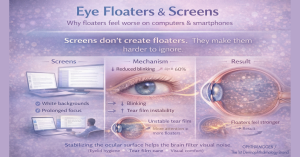
- People with prolonged screen use.
- Those exposed to air conditioning, heating, or dry environments.
- Patients with allergies or environmental sensitivities.
- Contact lens wearers.
- Women during menopause or with hormonal changes.
Just as brushing teeth starts in childhood, eye hygiene can begin early — as a daily health habit.
How Is Prevention Applied?

Prevention can be integrated into a simple daily routine, requiring only a few minutes:
- Thermal therapy & gland expression (e.g., Ophthalmogen EYE10 self-warming compresses).
- Eyelid Cleansing (using specialized products such as Ophthalmogen&Naviblef, not soap or plain water).
- Massage & circulation (gentle eyelid massage with Ophthalmogen Gel).
- Sprays & hydration (such as Ophthalmogen Spray to stabilize and protect the tear film).
Conclusion

Prevention is the most simple, economical, and scientifically proven way to protect health.
- In cardiology, it prevents heart attacks.
- In dentistry, it prevents tooth loss.
- In oncology, it prevents advanced cancer. In eye health, prevention safeguards vision quality, daily comfort — enabling focus on work and personal activities — and the beauty of the gaze.
Dermophthalmology establishes the new culture of eye hygiene.
Just as daily tooth brushing became second nature, so too should daily care of the eyelids and the Ophthalmoderma become second nature for our eyes.
For more practical eye care solutions, visit the Ophthalmogen range, the first in the world to apply the philosophy of Dermophthalmology.

Scientific Evidence for Prevention
- TFOS DEWS II (2017): defines dry eye as chronic and recommends patient education and lid hygiene as first-line management.
- TFOS MGD Workshop (2011): identifies meibomian gland dysfunction (MGD) as the most common cause of dry eye; recommends thermal therapy and gland expression.
- Jackson WB, 2008: daily lid hygiene reduces symptoms and improves quality of life.
- Korb DR et al., 2000: warm compresses + massage improve tear film stability.
- Arita et al., 2015: omega-3 supplementation improves meibomian lipid composition.
- Carreno et al., 2021 (Nature Biomedical Eng.): full eye replacement is not achievable with current technology.