
Why They Require Systematic Ophthalmic Monitoring and Eyelid Hygiene.
When the skin affects not only the surface — but vision itself.
- affect eyelid function
- destabilize the tear film
- cause chronic ocular discomfort
- significantly reduce quality of life
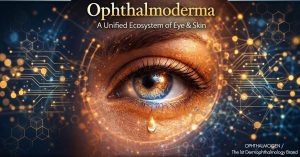
OPHTHALMODERMA & the Blepharo-Skin Axis.
The functional continuity between skin and eye.
Τhe OPHTHALMODERMA describes the interface zone involving:
- eyelid skin
- eyelash margin
- meibomian glands
- ocular surface
- the tear film
The Blepharo-Skin Axis (Blepharo-Skin Axis ) expresses the biological and functional connection: skin ⇄ eyelids ⇄ glands ⇄ tears ⇄ vision
This is not a theoretical conceptbut a daily clinical reality.
Embryological foundation (the core of Dermophthalmology)
The eyelid skin, eyelashes, and ocular surface: all originate from the ectoderm. προέρχονται από το εξώδερμα.
This means:
- shared biological behavior
- shared inflammatory response
- direct interaction between skin disease and ocular pathology
This explains why dermatological diseases often manifest with ocular symptoms..

Skin diseases with documented ocular involvement
Skin diseases with documented ocular involvement
Frequently associated with:
- eyelid eczema
- intense itching and rubbing
- chronic blepharitis
- meibomian gland dysfunction
American Journal of Ophthalmology, Cornea
Rosacea (Ocular Rosacea)
Up to 50–60% of patients present with:
- chronic eyelid inflammation
- MGD
- burning, stinging, photophobia
- “dry eye” unresponsive to drops
TFOS DEWS II, British Journal of Ophthalmology
Ocular symptoms often precede cutaneous signs.
Directly linked to:
- chronic blepharitis
- increased microbial load
- morning crusting
- unstable vision
May cause:
- chronic eyelid inflammation
- eyelash abnormalities
- indirect tear film instability
Requires systematic monitoring, especially in chronic disease.

The role of corticosteroids in dermatological patients
Many patients use topical corticosteroid creams on the face, often long-term.
Documented risks (even with cutaneous application):
- ↑ intraocular pressure → steroid-induced glaucoma
- accelerated cataract formation
- eyelid skin thinning → dark circles,
Τhe OPHTHALMODERMA is directly affected..
Why dermatological patients need eyelid hygiene
The Chronic cutaneous inflammation::
- extends to the eyelids
- disrupts meibomian gland function
- destabilizes the tear film
Eye drops alone are not sufficient. Required: daily eyelid hygiene - functional support of the Blepharo-Skin Axis

The role of morning eyelid hygiene
During the night it:
- lipids and secretions accumulate
- microbial load increases
- tear film stability decreases
This explains why many patients wake up with:
- stinging
- itching
- discharge
- “heavy” eyes
Morning eyelid cleansing with Naviblef Daily Care
Morning hygiene using Naviblef Daily Care foam, combined with lukewarm water, helps:
- gently remove secretions and lipids
- reduce microbial load
- improve comfort from early daytime hours
- enhance tolerance to dermatological treatments
Suitable for sensitive skin and long-term use.

Combined AM / PM routine
Morning
- Naviblef Daily Care
- Lukewarm water
- Clean eyelash base
- Massage with Ophthalmogen Gel directly after
Evening
- Ophthalmogen EYE10 (controlled heat therapy)
- Ophthalmogen Gel & Spray (balance / gentle massage & periocular spray)
This is not a treatment. It is functional hygiene of OPHTHALMODERMA.
Benefits of Ophthalmogen use in dermatological patients
- support of meibomian gland function
- reduction of chronic micro-irritation
- improved tear film stability
- fewer relapses
- enhanced quality of life
Conclusion
- Facial skin diseases are not “just skin”
- OPHTHALMODERMA is often overlooked
- The Blepharo-Skin Axis explains persistent symptoms
- Eyelid hygiene is a preventive medical act
- Quality of life improves substantially
- No fear
- Knowledge
- Routine
FAQ FAQ — Skin Diseases & the Eyes
- Why do skin diseases affect the eyes?;
Because skin and eye share a common embryological and functional origin (OPHTHALMODERMA).
- Do all dermatological patients need eyelid hygiene?
Yes, especially in chronic facial skin conditions.
- Are eye drops enough?
No. They relieve symptoms but do not restore eyelid function.
- Why is morning cleansing & massaging with Ophthalmogen important? Ophthalmogen;
It removes overnight microbial load and improves comfort throughout the day.
- Does eyelid hygiene replace treatment?
No. It complements treatment and makes it safer and more effective.