
Conditions, medications, and situations that may be associated with their appearance
Do Eye floaters are among the most common causes of concern related to vision. Although they are often perceived as an isolated ocular finding, in reality they represent a symptom whose perception and intensity can be influenced by multiple factors.
Specifically, floaters may be related to or affected by:
- changes inside the eye (vitreous body, retina),
- systemic medical conditions,
- inflammatory or autoimmune disorders,
- pharmacological treatments,
- lifestyle factors, stress, and visual fatigue.
Understanding these parameters helps distinguish:
- when floaters are a normal finding,
- and when they require further evaluation or increased attention.
Ocular conditions associated with floaters

Posterior Vitreous Detachment (PVD)
The most common cause of floaters, especially after the age of 40–50.
- a physiological, age-related change of the vitreous body,
- appearance of floaters with or without flashes,
- usually a benign condition.
An ophthalmic examination is recommended mainly at the initial onset, in order to rule out rarer complications.
High myopia
In individuals with high myopia:
- the eye has a longer axial length,
- the vitreous body is more susceptible to structural changes,
- floaters appear more frequently and at a younger age.

Mild vitreous hemorrhages
Small hemorrhages within the vitreous may present as:
- sudden increase in floaters,
- a sensation of “smoke” or shadow in the visual field.
These findings require prompt ophthalmological assessment.
After ocular surgery
Following cataract surgery or other intraocular procedures:
- the dynamics of the vitreous change,
- patients may perceive pre-existing floaters more clearly.
This usually does not indicate new pathology, but rather increased visual awareness.
Systemic conditions that may be associated
Diabetes mellitus
Diabetes may affect:
- the small retinal vessels,
- the transparency of the vitreous.
Symptoms:
- floaters,
- blurred or unstable vision,,
- fluctuations in visual clarity.

Arterial hypertension
Hypertension can lead to:
- vascular changes,
- micro-hemorrhages,
- transient visual disturbances.
In this context, floaters should be evaluated, especially if they are newly perceived.
Inflammatory / autoimmune disorders
Conditions such as uveitis or vasculitis:
- cause inflammation inside the eye,
- are often accompanied by persistent floaters.
In these cases, floaters are a manifestation of inflammation, not a simple incidental finding.
Medications that may affect vision and make floaters more noticeable

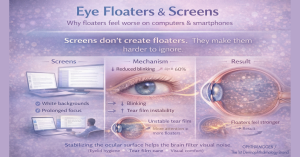
- Important scientific clarification - The following medications do not directly cause floaters.However, they may affect:
- image stability,
- the tear film,
- visual perception and the brain’s attentional focus.
As a result, pre-existing floaters may become more noticeable and disturbing..
Isotretinoin (Isotretinoin – Roaccutane® and equivalents)
Widely used for severe acne.
Known ocular effects:
- significant dry eye,
- meibomian gland dysfunction,
- an unstable tear film,
- blurred or “dirty” vision.
Many patients report that they “see floaters,” while in reality they experience visual instability, which makes shadows more apparent.In this setting, eyelid hygiene is crucial.
Antidepressants & anxiolytics
Categories include:
- SSRIs: sertraline (Zoloft®), escitalopram (Lexapro®), fluoxetine (Prozac®),
- SNRIs: venlafaxine (Efexor®), duloxetine (Cymbalta®),
- Benzodiazepines: alprazolam (Xanax®), lorazepam (Ativan®).
Possible effects:
- altered visual accommodation,
- transient blurring,
- increased visual hyper-focus.
Floaters do not increase, but the brain tends to “scan” them moreespecially under anxiety.
Medications for erectile dysfunction (PDE-5 inhibitors)
Active substances and brands:
- sildenafil (Viagra®),
- tadalafil (Cialis®),
- vardenafil (Levitra®).
Known visual side effects:
- altered light perception,
- photopsias,
- transient blurring.
When combined with ocular dryness and poor eyelid hygiene, floater-related discomfort may intensify.
Corticosteroids (cortisone)
How to use
- oral,
- injectable,
- long-term or high-dose regimens.
- changes in intraocular pressure,
- blurred vision,
- visual instability.
When combined with ocular dryness and poor eyelid hygiene, floater-related discomfort may intensify.
The role of stress and lifestyle
Stress:
- does not create floaters,
- but significantly increases their perception.
Additional contributing factors include:
- lack of sleep,
- dehydration,
- prolonged screen exposure.
All of these reduce overall visual comfort.
Why eyelid hygiene helps in all these situations

A common denominator in many of the above conditions is:
- an unstable tear film,
- image fluctuations,
- increased brain sensitivity to shadows.
Eyelid hygiene:
- does not alter the vitreous body,
- but cleans and stabilizes the “optical filter” before the image reaches the retina.
As a result, floaters become less dominant in visual perception.
Practical Ophthalmogen routine for visual stability
Evening – Ophthalmogen EYE10
- gentle warmth to the eyelids,
- liquefaction of meibum,
- support of meibomian gland function.
Morning – Ophthalmogen Gel
- cleansing of the eyelid margins,
- gentle massage,
- removal of overnight debris.
During the day – Ophthalmogen Spray
- hydration
- comfort during screen use and air-conditioning,
support of the ocular surface.
Conclusion
Eye floaters are not always a simple finding.They may be associated with medical conditions, medications, or situations that affect visual quality.The correct approach is not panic, but:
- awareness,
- appropriate examination when needed,
- and consistent daily care of the ocular surface.
Eyelid hygiene does not “eliminate” floaters,but it can significantly reduce discomfortand improve overall quality of life..
Disclaimer
This article is for informational purposes only and does not replace a medical examination.
If you would like help finding the right ophthalmologist for your case, you can contact: info@ophthalmogen.com