
Eye Floaters and Dry Eye: Why People Get Confused and Why the Symptoms Overlap
Many people who notice eye floaters also report, at the same time:
- blurry or dirty vision
- a sensation of dryness, burning, or tightness
- excessive tearing
- heavy eyes or eye fatigue
- worsening of symptoms in the morning or after prolonged screen use
Naturally, they begin to ask:
“Is floaters or is it Dry eye?”“Can dry eye actually cause floaters?”
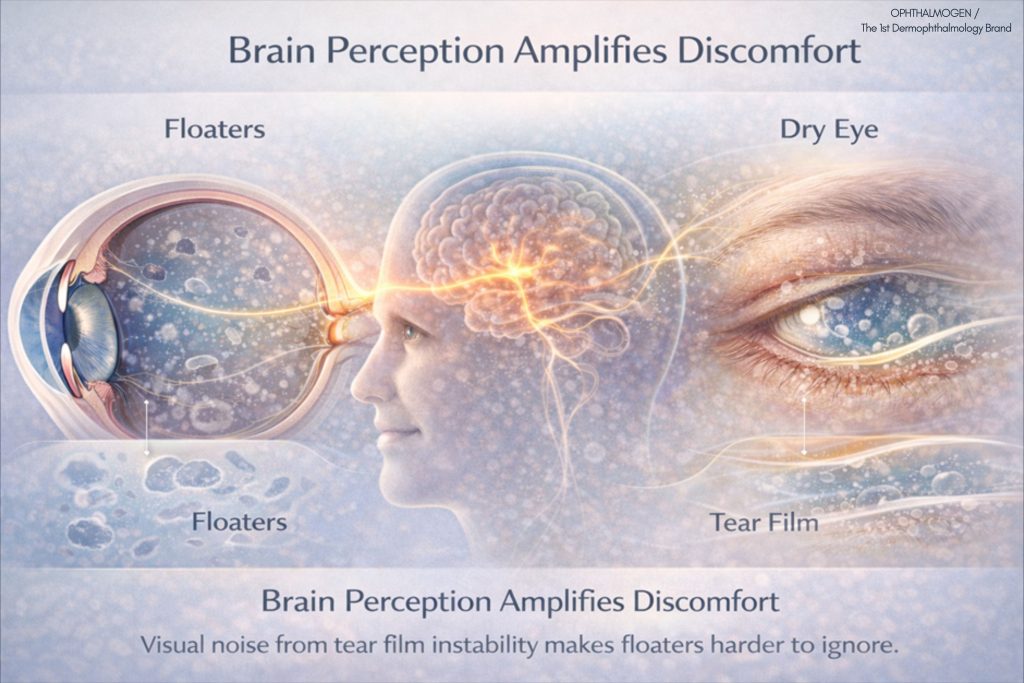
The truth is that two completely different mechanisms are being confused — mechanisms that, however, intersect at the level of brain perception.
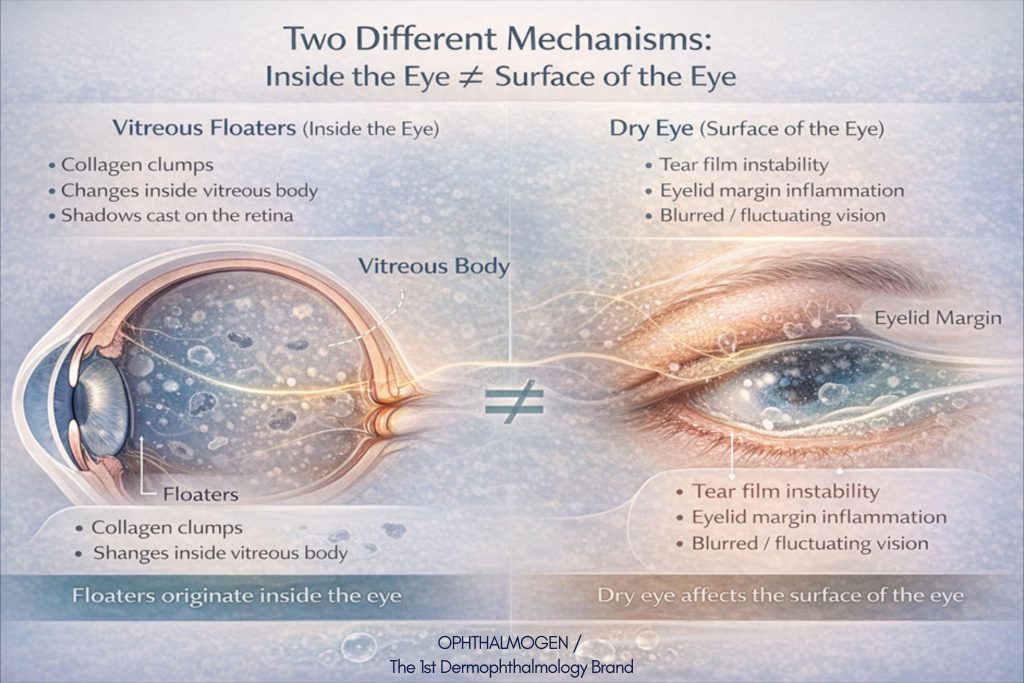
Eye Floaters and Dry Eye: Two Different Mechanisms
Eye floaters:
- originate from the vitreous body(inside the eye)
- are shadows cast onto the retina
- are related to structural changes of the vitreous
- are not caused by dry eye
Dry eye:
- affects the ocular surface
- is related to the quality and stability of the tear film
- influences how the image is formed, not what exists inside the eye
Key takeaway: Dry eye does not create floaters, but it can make them far more disturbing.
Why the Symptoms Are So Often Confused
Dry eye commonly causes:
- fluctuating or intermittent blur
- a “film” or veil-like sensation
- micro-fluctuations in visual clarity
- frequent blinking
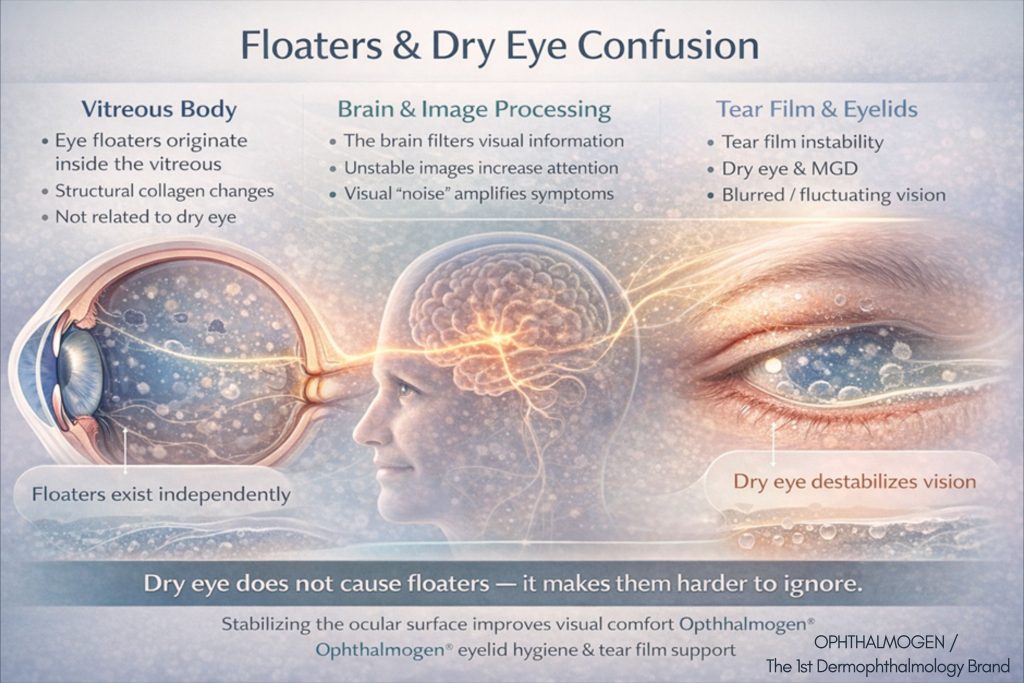
These fluctuations:
- destabilize the image
- αυξάνουν την εγκεφαλική προσοχή
- highlight every shadow or movement
As a result, floaters that already existed:
- are noticed more frequently
- appear more intense
- dominate the daily visual experience
Dry Eye as a “Magnifying Lens” for Floaters
When the tear film is unstable:
- the image fails to remain clear
- the brain constantly tries to correct it
- sensory alertness increases
In this context:
- the number of floaters does not increase
- the perception of floaters increases dramatically
This explains why many people say:
“When my eyes are dry, my floaters bother me much more.”
Scientific Background — What Research Shows
Dry Eye & Image Quality
TFOS DEWS II Report – The Ocular Surface
Tear film instability: a tear film issue:
- reduces visual stability
- increases “visual noise”
- worsens subjective visual discomfort
The image becomes more “nervous” — not the eye more diseased.
Dry Eye & Subjective Symptom Burden
Lietal., Cornea
- Strong correlation between:
- dry eye symptoms
- visual fatigue
- heightened symptom awareness
The clinical finding may stay the same, but the experience changes.
The Role of the Eyelids
Knopetal., Ocular Surface
- accelerates tear evaporation
- destabilizes the tear film
- increases visual discomfort
In many cases, the problem is not the tears — but the eyelids.
Why Tearing Does Not Exclude Dry Eye
A very common misconception:“If my eyes are tearing, I can’t have dry eye.”
In reality:
- this is often reflex tearing
- the tears are poor in quality
- do not stabilize the tear film
The result is blurred vision and greater awareness of floaters.
The Critical Role of Eyelids
In most cases, dry eye:
- begins with eyelid dysfunction
- is associated with:
- blepharitis
- MGD
- an inadequate lipid layer
When eyelids do not function properly:
- the tear film breaks up quickly
- the surface becomes irregular
- floaters stand out more clearly
How Proper Care Helps (Realistically & Scientifically)
Important:Care does not alter the vitreous and does not eliminate floaters.
However , it:
- stabilizes the visual image
- reduces visual noise
- allows the brain to ignore floaters more easily
Supportive Daily Routine with Ophthalmogen
Evening — Ophthalmogen EYE10 Self-heating sterile compresses
- gentle heat
- improved meibum fluidity
- preparation of the ocular surface
Πρωί— Ophthalmogen Gel Massage eyelids
- eyelid margin cleansing
- removal of debris that blurs vision
During the Day — Ophthalmogen Spray
- hydration without interrupting activity
- comfort during screen use and air conditioning
Goal: a more stable image → less focus on floaters.
FAQ – Frequently Asked Questions
Can dry eye cause floaters?
No. But it can make them far more noticeable.
Why do the symptoms overlap?
Because image instability increases brain attention.
Does tearing rule out dry eye?
No. It is often reflex tearing.
Does eyelid hygiene really help?
Yes. It stabilizes the tear film and reduces discomfort.
Do Ophthalmogen products remove floaters?
No. They reduce visual instability that amplifies them.
Conclusion
Dry eye does not cause eye floaters,but it can make them significantly more disturbing.
The confusion arises because:
- the surface becomes irregular
- the brain increases attention
- floaters move into the foreground of perception
Proper eyelid hygiene and ocular surface care are essential for:
- clearer vision
- less discomfort
- improved quality of life
Disclaimer:This article is for informational purposes only and does not replace a medical examination.